Apr 16. 2026 - 学院动态
导语
2026年3月23日上午,南方科技大学创新创意设计学院院长关道文受邀参加在深圳海上世界文化艺术中心举办的DIA湾区智造论坛,并发表主旨演讲。
DIA湾区智造论坛由中国美术学院、招商文化|设计互联主办,中国设计智造大奖、深圳海上世界文化艺术中心、中国美术学院文创设计制造业协同创新中心、国际设计智造联盟联合承办。
本次DIA湾区智造论坛依托展览“两个AI——艺术智性与数字智能创新设计”展开。该展览以“人工智能”与“艺术智性”为核心概念,探讨智能时代背景下技术理性与人文创造力的协同关系。论坛在此基础上延展讨论,探讨技术变革时代下人工智能与艺术智性相互融合,共同进化的思辩过程。
关道文在本次演讲中围绕“设计、场景与智能”主题,正是在这一框架下展开,探讨人工智能背景下设计角色与方法的转变。他指出,设计已由以往面向单一产品的形态塑造,转向在复杂多变的场景中构建系统与组织行为。人工智能能够提升感知与预测能力,但在理解场景中的角色、行为意图、优先级与规范等方面仍存在局限,需通过设计加以引导与整合。基于此,演讲提出“场景工程”的视角,强调设计师可以通过对场景的主动建构,使智能技术能够在实际应用中有效运行,并在人类经验中呈现为清晰、可信且适配的系统形态。结合制造、医疗与养老等领域案例,进一步阐明设计在优化人机协作、提升系统可理解性与可靠性方面的关键作用。演讲同时指出,面向未来,设计教育需强化系统思维与跨领域整合能力,以支撑人工智能在社会与产业中的深入应用与发展。
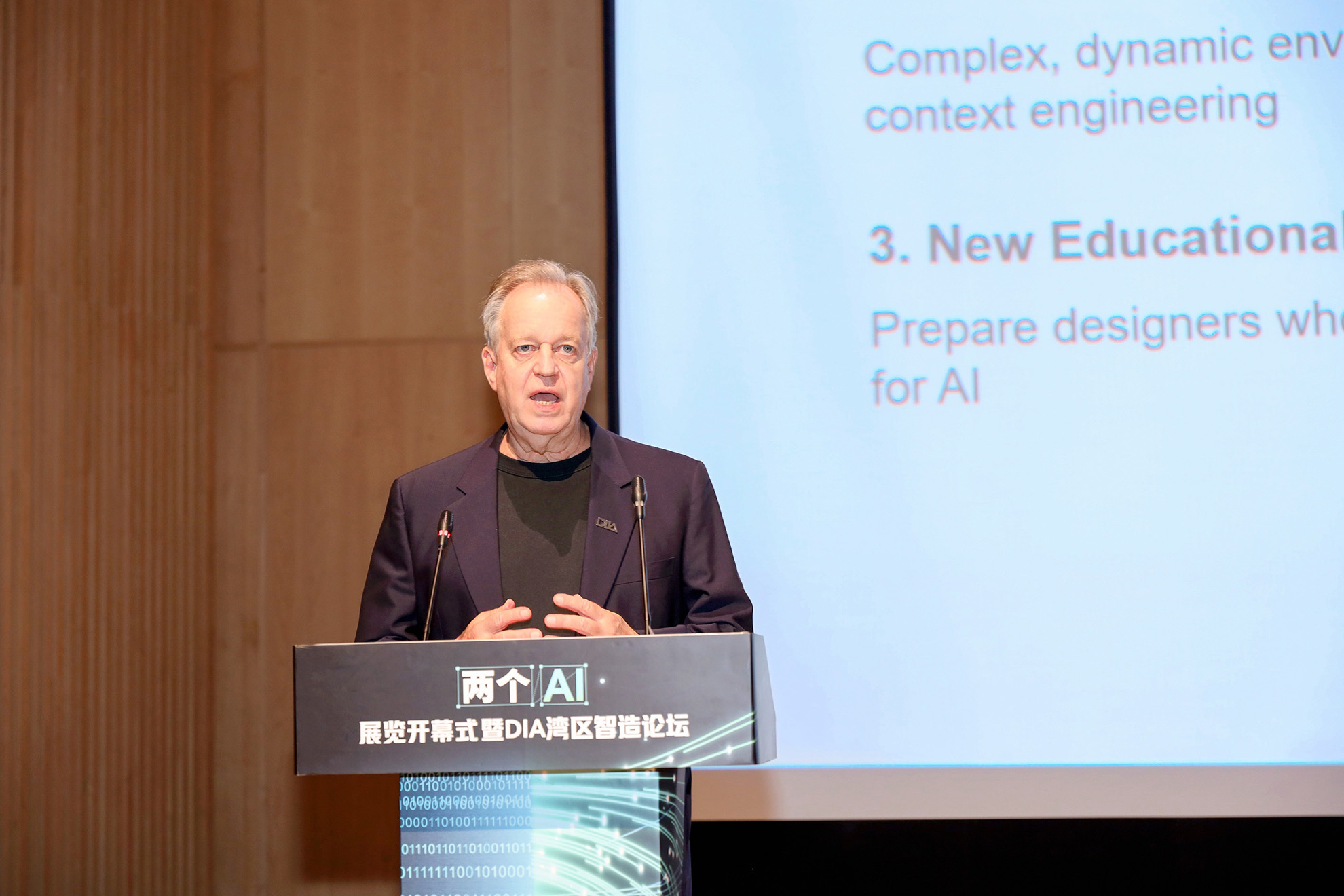
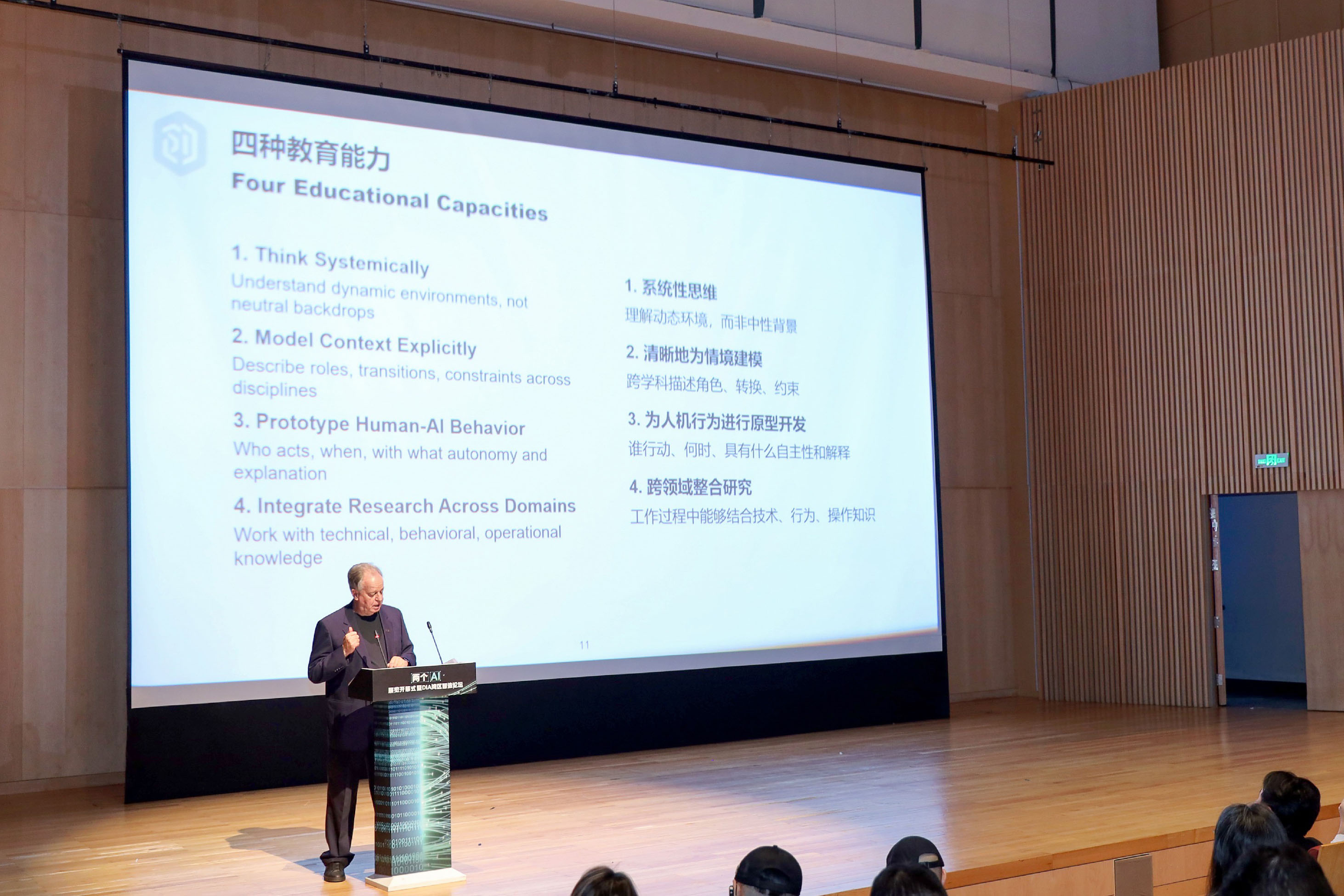
南方科技大学创新创意设计学院院长关道文(Thomas Kvan)进行主旨演讲
以下为关道文院长的完整演讲内容:
(引用请注明出处)
设计、场景与智能
Designing Intelligence in Context
1
尊敬的各位来宾、各位同仁、朋友们:非常感谢主办方的邀请。设计智造大奖已成为推动设计、科技与智能制造深度对话的重要平台,我尤为荣幸能参与本次活动。
本次论坛与巡展的结合,让这一平台的价值愈发凸显:我们不仅探讨人工智能能做什么,更思考设计如何让人工智能在社会与产业中落地成形、发挥价值。
Distinguished guests, colleagues, and friends,
Thank you for the invitation to speak today. I am especially honored to join this event, because the Design Intelligence Award has become an important platform for bringing design, technology, and intelligent manufacturing into productive dialogue.
This forum, together with the touring exhibition, makes that role very visible: it asks not only what AI can do, but how design gives it form in society and industry.
2
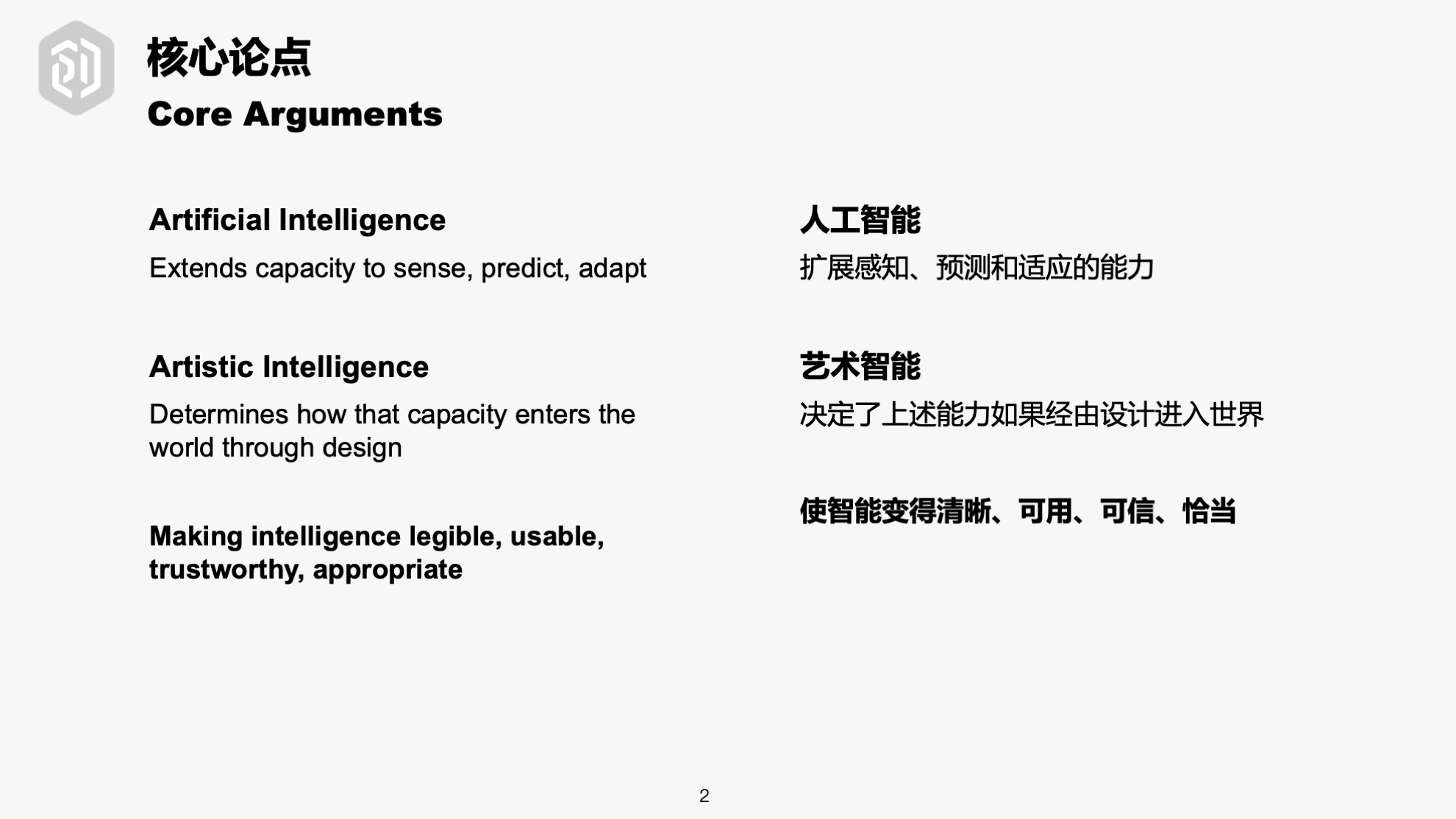
人工智能拓展了我们感知、预测与适应世界的能力。而我今天所提及的 “艺术智能”这一概念,则是人类通过设计为这种智能赋予形态、意义与价值判断的能力。
如果说人工智能是能力的延伸,艺术智能则决定了这种能力如何走入现实:如何变得清晰易懂、易用实用、值得信赖、适配场景。作为教育工作者,我关注的核心是,如何培养新一代人才掌握这种能力。这是我今天发言的主题。
我想先提出三个核心观点:
Artificial intelligence increases our capacity to sense, predict, and adapt. Artistic intelligence, as I will use the term today, is the human capacity to give that intelligence form, meaning, and judgment through design.
So if artificial intelligence extends capability, artistic intelligence determines how that capability enters the world: how it becomes legible, usable, trustworthy, and appropriate. As an educator, my focus is how we equip our emerging generations with these capabilities.
That is the theme of my remarks today.
I will start with three claims.
3
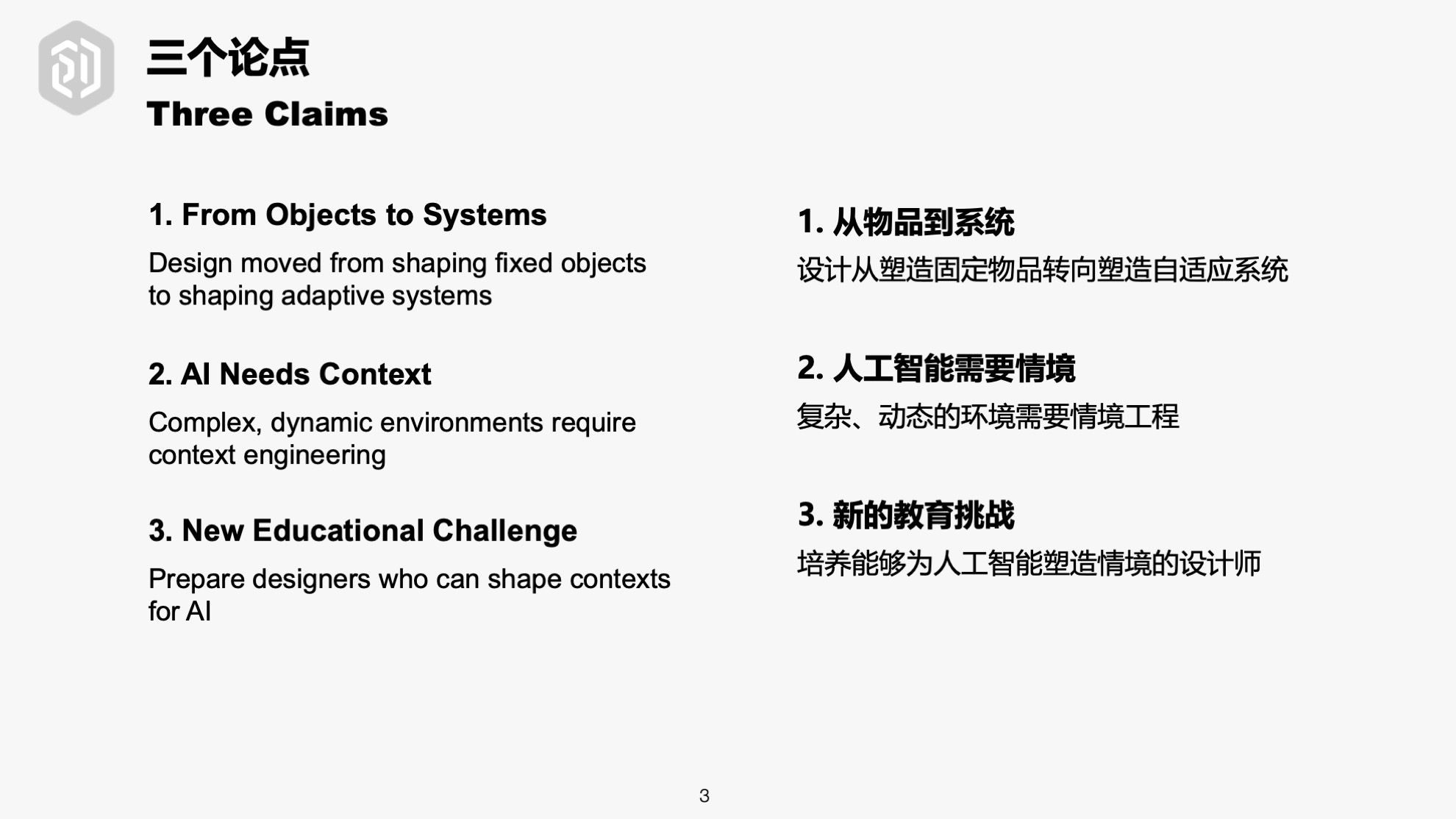
第一,设计已从塑造固定产品,转向在动态场景中塑造系统。第二,当下这样诸多的动态场景都具有复杂性与适应性,因此人工智能的有效运转离不开具体的场景。第三,这催生了一项新的教育任务:我们必须培养能够践行 “场景工程” 的设计师。
我从一个大家熟知的例子说起。
First, design has moved from shaping objects to shaping systems in changing situations.
Second, many of those situations are now complex and adaptive, so AI needs context in order to work well.
Third, this creates a new educational task: we must prepare designers who can practice what I would call context engineering.
Let me begin with a familiar example.
4
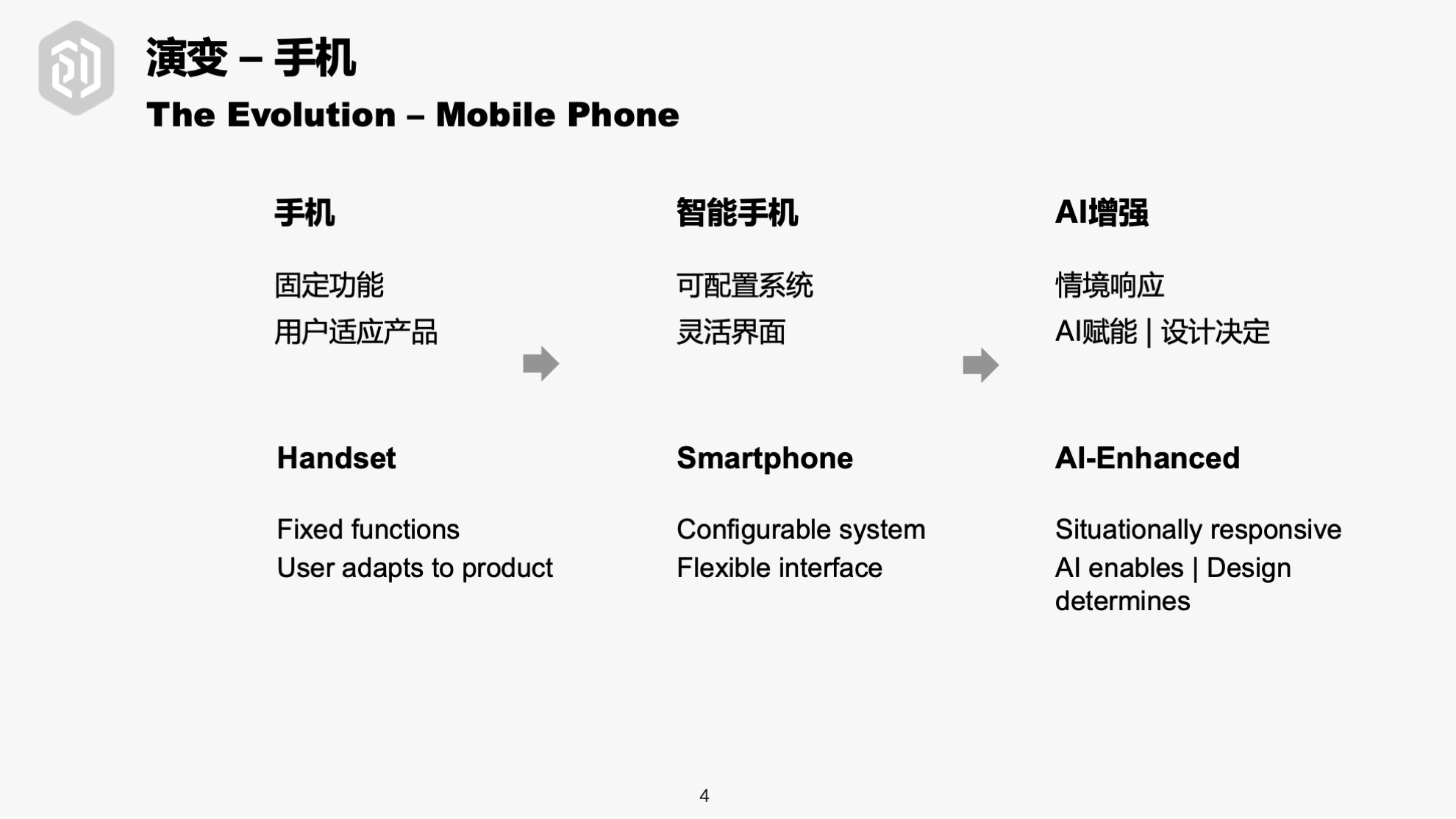
二十年前,手机还只是一种通讯终端,功能固定且有限,操作界面基本稳定,用户需要去适应产品本身。那时的设计,核心聚焦于物品本体:机身的重量、握持的手感、按键的辨识度、屏幕的可读性,以及物理交互的精准度。
然后智能手机问世了。产品变得更开放、更具可配置性、更有层次感。用户可以安装应用、自定义功能、调整设置,每一部设备都独一无二。
设计也随之改变了。设计不再只关注单一物品的自洽,还要兼顾整个系统的统一性:构建一套界面架构、视觉语言、交互模式,让设备在支持多样化配置的同时不陷入混乱,始终保持体验的有序与连贯。
如今,人工智能再次重塑了这一设备。今天的智能手机能够学习用户习惯、挖掘行为规律、根据不同场景做出差异化响应。它可以重新排序信息、主动给出建议、动态调整推荐内容,并依据时间、地点、活动预判并适配使用行为。
这让设计的作用变得更加重要。
Twenty years ago, the mobile phone was still primarily a handset. It offered a limited set of fixed functions. Its interface was largely stable and the user adapted to the product. In that period, design focused on the object itself: its weight, its feel in the hand, the clarity of its keypad, the legibility of its screen, the precision of its physical interface.
Then the smartphone arrived. Now the product became more open, more configurable, and more layered. Users installed apps, rearranged functions, changed settings, and each device was unique. Design changed as well. Design was no longer only about the coherence of one object. It was also about the coherence of a system: an interface architecture, a visual language, and an interaction model that could support many different configurations without becoming chaotic.
Now AI is changing that device once again. Today the smartphone can learn routines, infer patterns, and respond differently to different circumstances. It can reorder information, propose suggestions, adapt recommendations, anticipate and change behavior according to time, place, and activity.
This makes the role of design more important.
5
哪些信息应该成为核心重点?哪些适配操作应该自动完成?哪些权限应始终交由用户掌控?系统该如何清晰展示自身的运行状态与背后逻辑?智能辅助在何种情况下会变成对用户的干扰?这些问题,不仅是技术问题,更是设计问题。
所以,我得出第一个观察是:
我们已从设计固定形态的产品,转向设计能够实现多样化行为的系统。人工智能让这一切成为可能,而依托设计实现的艺术智能,则决定了这种可能性在何时、如何转化为实际价值。
这引出了一层更广泛的涵义。
往往在公共讨论中,设计仍常被误解为于装饰,认为其核心只是关乎外观。但我们深知,设计的本质,是构建具体场景中的行动。
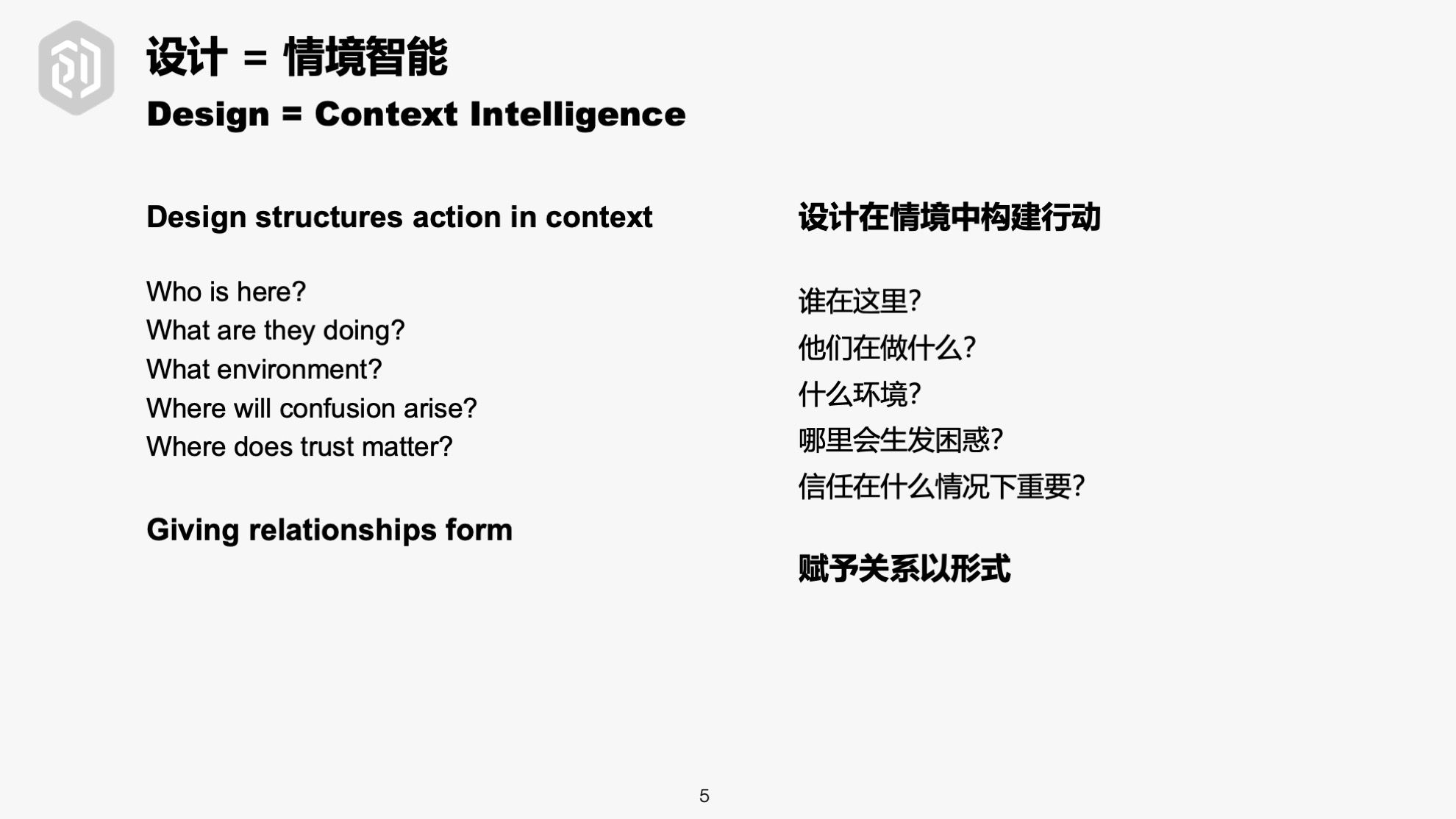
设计师会思考:使用者是谁?他们想要达成什么目标?他们身处怎样的环境?存在哪些潜在风险?哪些环节容易产生困惑?哪些场景下信任最为重要?
而后,设计师为这些关系赋予具体的形态 —— 可能是物理形态,也可能是操作界面、工作流程;可能是空间布局、视觉层级、声音逻辑,也可能是一系列的交互环节。无论何种形式,设计都远不止于塑造物品的造型,而是让具体场景变得清晰可辨、让行为变得可行可落地。
这也是我为何在此坦然使用 “艺术智能” 这一概念 —— 前提是我们对其有准确的理解。
艺术智能不是装饰性应用,而是根植于美学的道德哲学,这在中国有着深厚的传统底蕴。艺术智能,是人类经培养后所具备的核心能力:解读场景语境、塑造价值意义,让新兴的智能形态以适配的方式融入现实世界。
而这种能力,正是通过设计得以实现。
这也是本次展览的价值所在。通过展示设计智造奖在具身智能、元宇宙、低空经济等领域的获奖作品,我们能够清晰看到,艺术智能与人工智能的融合并非抽象概念,而是已在诸多新兴领域形成了具象的落地成果。
Which information should matter? Which adaptations should happen automatically? Which should remain under user control? How does the system indicate what it is doing, and why? At what point does assistance become intrusion?
These are not only technical questions. They are design questions.
So the first observation is this:
We have moved from designing fixed objects to designing systems capable of varied behavior. Artificial intelligence makes that possible. Artistic intelligence, working through design, determines when and how that possibility becomes valuable.
This leads to a broader point.
At times, especially in public discussion, design is still confused with decoration and mainly a matter of appearance. But, as we know, design is the discipline that structures action-in-context.
A designer asks: who is here, what are they trying to do, what environment are they in, what risks are present, where will confusion arise, and where will trust matter most?
Then the designer gives those relationships form. That form may be physical form, or it may be an interface, a workflow. It may be a spatial arrangement, a visual hierarchy, a sound logic, or a sequence of interactions. In every case, design is doing more than styling an object. It is making a situation intelligible and actionable.
That is why I am comfortable using the phrase artistic intelligence here, provided we understand it carefully.
Artistic intelligence is not the decorative application but grounded in the moral philosopy of aesthetics, a profoundly deep tradition in China. Artistic intelligence is the cultivated human capacity to interpret context, shape meaning, and give emerging forms of intelligence an appropriate presence in the world.
And that capacity is realized through design.
That is also why the exhibition matters. By presenting DIA-recognized works in areas such as embodied AI, the metaverse, and the low-altitude economy, it shows that the meeting of artistic intelligence and artificial intelligence is not abstract; it is already taking material form in emerging domains.
6
为什么这一点在当下尤为重要?因为我们部署人工智能的场景,并非静止不变的。工厂、医院、城市,都是动态发展的系统,环境条件不断变化,系统中一个环节的微小变动,都可能在其他环节引发大的连锁反应。
换言之,我们如今所设计的诸多系统,都属于复杂适应系统。在这样的场景中,固定的产品或界面往往难以满足需求,固定的工作流程也极为少见,设计的工作内涵也因此发生了根本变化。
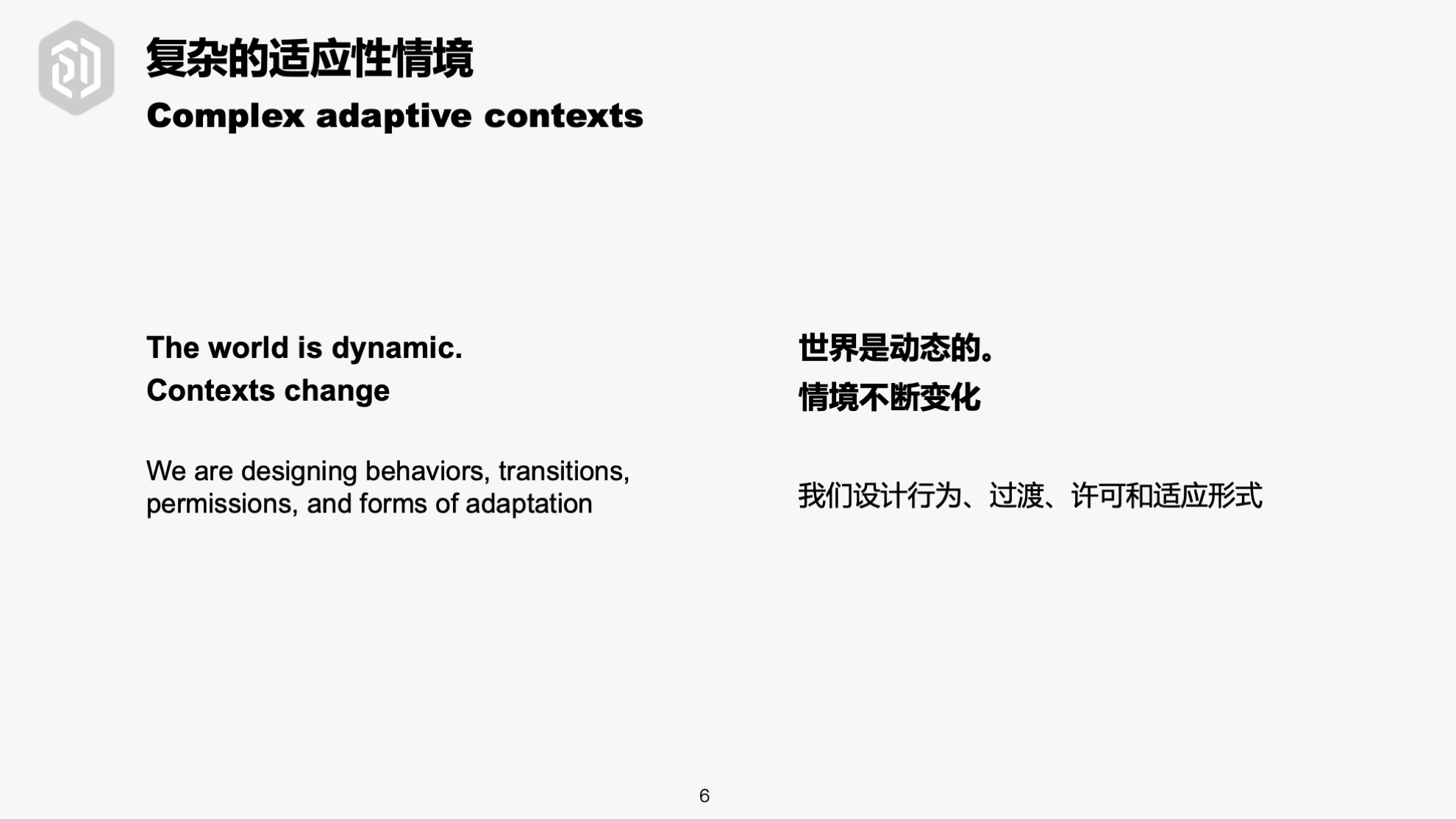
我们不再只是设计产品,更是在设计行为、过渡环节、权限体系与适配模式;我们不仅设计系统的当下形态,更设计系统如何随场景变化而动态调整。
Now, why does this matter so much today? Because the settings in which we are deploying AI are not static. Factories, Hospitals, Cities are dynamic. Conditions change. Small changes in one part of the system can have large effects elsewhere.
In other words, many of the systems we now design for are complex adaptive systems. In such settings, a fixed object or interface is rarely sufficient. A fixed workflow is unusual. So the work of design also changes.
We are no longer only designing products. We are designing behaviors, transitions, permissions, and forms of adaptation. We are designing not only what a system is, but how it changes as circumstances change.
7
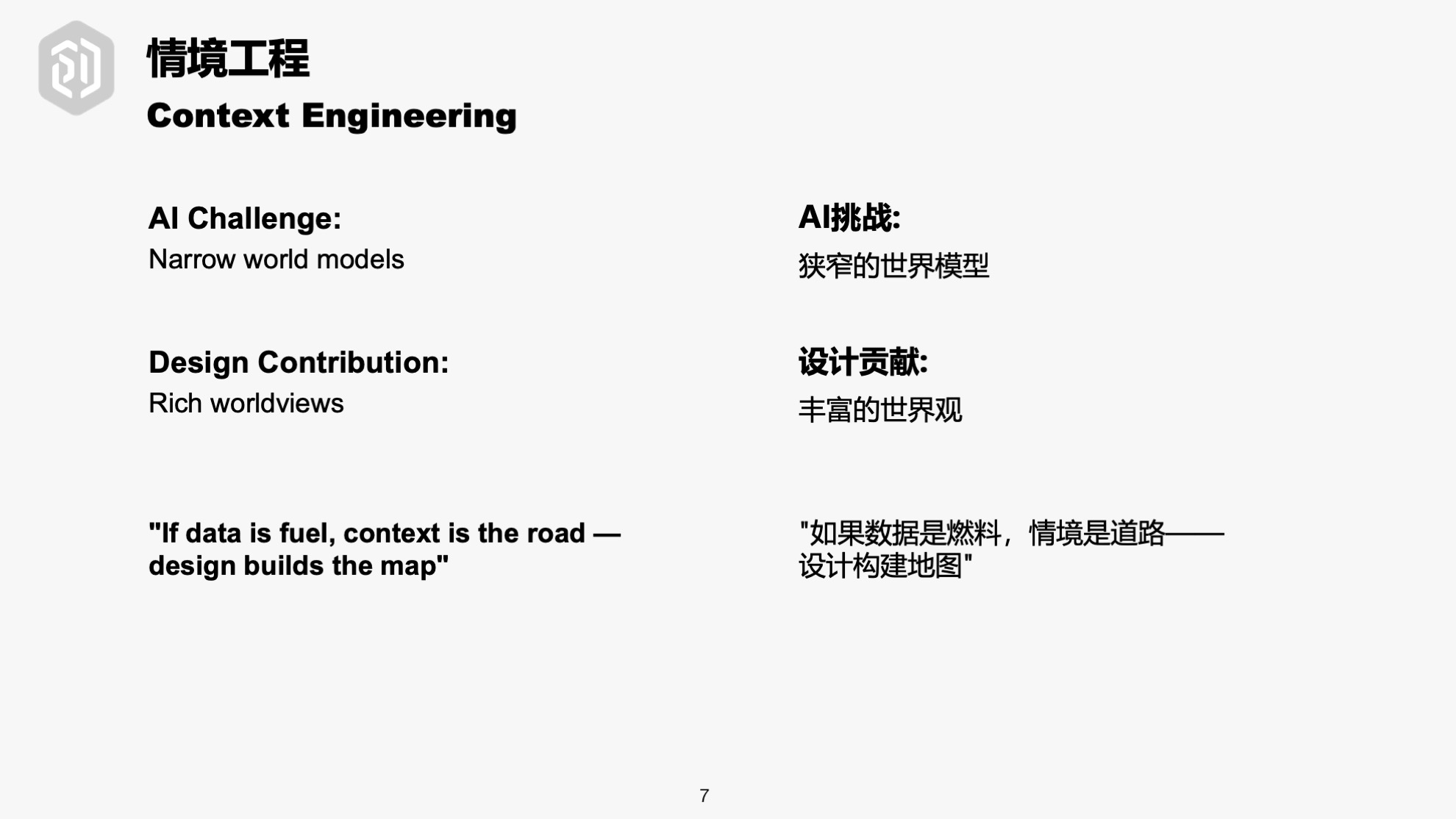
人工智能通常基于狭隘的世界模型运作。它能从数据中识别规律,但无法像我们人类实践者那样在具体场景中自动理解分工角色、行为意图、优先级、行为规范、特殊例外事件、后果机制等等。设计师则是面向丰富得多的世界观工作,而“场景工程学”则是使得这些世界观明晰到AI可以运用的程度。
在目前人工智能领域里,“场景工程学”已经是一个既有术语,通常指通过大语言模型的上下文窗口提升模型的表现与准确性。我想进一步拓展这个术语:场景工程学,是指通过主动、有意识地塑造场景,使得任何形式的智能(人类的或人工的智能)都能够恰当地应用于其中。
目前的空白是有影响的。智能远不止于预测,更在于时机的把握、目的的明确、逻辑的解释与权限的界定。使用者是专家还是新手?哪些事项需要立即处理,哪些可以暂缓?系统何时该给出建议、发出预警、保持静默、或主动停止?这些基于场景的判断都是设计师的责任,设计师将其清晰传递给设计、工程与运营的各个环节。
如果说数据是智能的燃料,语境就是智能行驶的道路,这条路需要地图。设计帮助绘制这个地图:世界观使得智能具备意义。人工智能可以提供能源动力,而依托设计实现的艺术智能,则助力打造出让这份能源动力平稳前行的道路。
接下来,我将通过三个具体案例,让这一理念变得更为具象。
在每个案例中,我都会清晰区分人工智能的贡献与设计的贡献。这一区分很重要,否则设计的价值就会被淹没在泛化的技术叙事中。
Artificial intelligence is powerful, but it is often weak in context. It can identify patterns in data, but it does not automatically understand roles, intentions, priorities, norms, exceptions, or consequences in the way human practitioners do.
This is where I find the concept of context engineering useful. Already an established technical term in AI engineering, it refers to LLM's context window to improve AI agent performance and accuracy. Today, I want to extend this, so by context engineering, I mean the deliberate work of making situations explicit enough for intelligence to act well within them.
That gap matters. Intelligence isn't just prediction, it is timing, purpose, explanation, and authority. Who is expert or novice? What needs attention now or can wait? When should the system suggest, warn, stay silent, or stop? These contextual judgments fall to designers, who must make them explicit for design, engineering, and operations. If data is the fuel of AI, context is the road. Artificial intelligence may supply power. Artistic intelligence, working through design, helps shape the road on which that power can travel.
Let me now make this concrete through three examples.
In each case, I want to separate clearly what artificial intelligence contributes, and what design contributes. That distinction is important, because otherwise design disappears into a general story about technology.
8
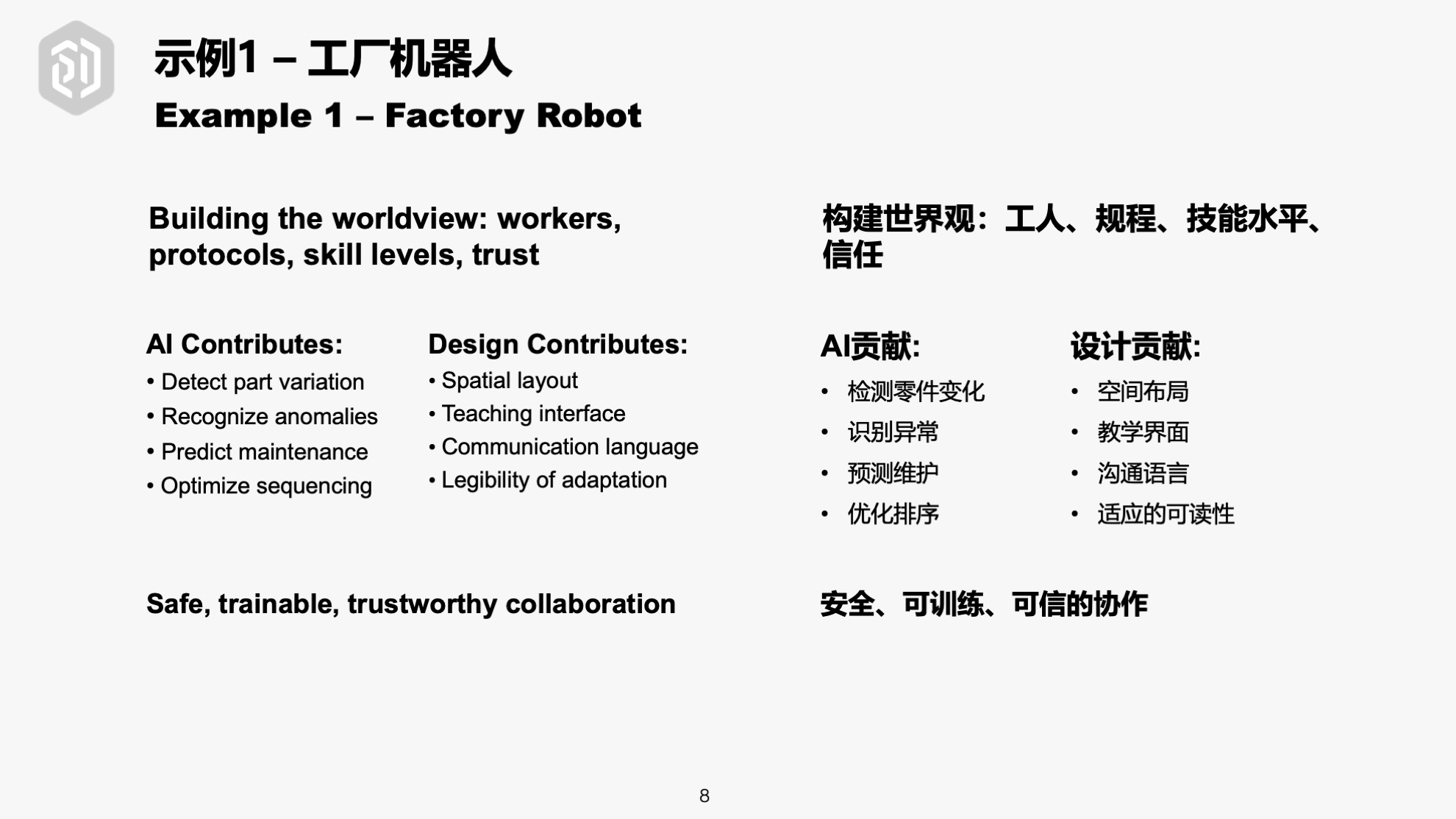
第一个案例是工厂机器人,跟本次论坛的核心主题 —— 智能制造高度契合。我们先来看传统的工业机器人。经典的工业机器人能力出众,但应用边界高度固化:它在划定的作业单元内工作,重复固定的操作流程,要求零部件规格统一、作业时序稳定,工作环境基本保持不变。
在这种场景下,设计是在场的,但相当有限:主要体现在机械臂的作业范围设计、急停按钮的布局、操作面板的结构、警示标识的视觉编码,以及帮助工作人员判断危险边界的阈值设定等方面。
现在我们来看协作机器人,在这里整个系统更加开放。协作机器人可以与人类近距离协同工作,能够被教授新的任务,可在不同工具、产品、工作流程间切换,工厂的作业单元没那么固定了,人机交互的重要性愈发凸显。
在这一阶段,人工智能与设计的区别更清楚了。人工智能能够助识别零部件的偏差、检测异常情况、评估不确定性、预判设备维护需求、优化作业时序;而设计,则决定了这些能力如何在作业单元中落地成形。
设计塑造空间布局:工人的站位、靠近作业单元的方式,以及人们对作业范围、设备速度、潜在风险的感知方式。设计打造教学界面:机器人是只能由专业人员重新编程,还是经过培训的操作员就能通过演示、手势或清晰的视觉流程进行引导。设计打造沟通语言:通过灯光状态、声音提示、屏幕层级、运动特征,让机器人向人类传递就绪、警示、中断、邀请等不同信号。
这早已超越了单纯的造型设计,而是对 “协作” 本身的设计。
我们再进一步,看看智慧工厂中的场景感知机器人。
一个真实的工厂并非受严格控制的演示场景:工人会轮岗换岗,技能水平参差不齐,产品缺陷率时有波动,紧急订单随时出现,上游环节的问题会影响下游的作业,设备的维护状态会让同一操作产生不同的结果。
人工智能能够检测到这些变化,能够推断出作业现场有新手工人、产品质量出现偏差或生产需求变得紧急,但设计,决定了这些智能判断如何呈现、如何被落地执行。
面对新手工人,界面可能会变得更直观:指引标识更大、作业流程更清晰、操作过渡更平缓、确认环节更明确,设备的运动状态也会显得更为谨慎,而非突兀。而面对专业工人,同一系统则会变得更精简:提示信息更少、信息密度更高、操作过渡更快捷,赋予使用者更大的操作自由度。
当产品缺陷率上升时,人工智能能感知到不确定性的增加,而设计则决定了这种不确定性会转化为刺耳的警报、让人困惑的提示,还是实用的指导。设计贡献了清晰的辨识度、高效的协调性、可靠的信任度,以及安全的协作模式。
优秀的人工智能可以提升生产效率,而优秀的设计,则让自适应自动化变得足够易懂,便于培训;足够可靠,便于落地;足够稳健,能够支撑工厂的日常运营。
The factory robot is especially relevant today because intelligent manufacturing is at the center of this forum.
Let us begin with the traditional industrial robot. In its classical form, it is a highly capable but tightly bounded object. It works inside a defined cell. It repeats a known sequence. It assumes consistent parts, consistent timing, and a largely frozen environment.
In that setting, design is present, but in a relatively limited way. It shapes the physical reach of the arm, the placement of emergency stops, the structure of the control pendant, the visual coding of warnings, and the thresholds by which a person understands where danger begins.
Now move to the collaborative robot. Here the system becomes more open. The robot may work closer to people, be taught new tasks. It may shift between tools, products, or workflows. The factory cell becomes less fixed, and the interaction between person and machine becomes more important.
At this point, the difference between artificial intelligence and design becomes much clearer. Artificial intelligence may help recognize part variation, detect anomalies, estimate uncertainty, anticipate maintenance, or optimize sequencing. Design determines how those capabilities are embodied in the workcell.
Design shapes the spatial layout: where a worker stands, how a person approaches the cell, how reach, speed, and risk are perceived. Design shapes the teaching interface: whether the robot can only be reprogrammed by a specialist, or whether a trained operator can guide it through demonstration, gesture, or a clear visual workflow. Design shapes the communication language: the light states, sound cues, screen hierarchies, and motion signatures through which the robot communicates readiness, caution, interruption, or invitation.
This is already far more than styling. It is the design of collaboration.
Now take the next step: the context-aware robot in a living factory.
A real factory is not a controlled demonstration. Workers change roles. Skill levels vary. Defect rates rise and fall. Urgent orders appear. Upstream problems affect downstream behavior. Maintenance status changes the meaning of the same action. Artificial intelligence may detect these changes. It may infer that a novice worker is present, that quality has drifted, or that production urgency has increased. But design determines how that intelligence appears and how it is acted upon.
For a novice worker, the interface may become more explicit: larger guidance, clearer sequencing, slower transitions, more obvious confirmation, and motion that reads as careful rather than abrupt. For an expert, the same system may become more compact: fewer prompts, denser information, quicker transitions, and greater freedom of action.
If defect rates rise, AI may register increased uncertainty. Design decides whether that uncertainty becomes alarm, confusion, or useful guidance. Design contributes legibility, coordination, trust, and safe collaboration.
Good AI may improve throughput. Good design makes adaptive automation understandable enough to train, trustworthy enough to deploy, and robust enough for everyday factory use.
9
第二个案例,我们将目光投向医院。
传统的输液泵是一款边界明确的设备,由医护人员直接编程操作,智能程度有限,操作界面仅存在于设备本地,运行逻辑相对固定。这种情况下的设计,核心聚焦于设备形态与界面的清晰度,比如按键的造型、屏幕的层级、把手的布局、警报的可听度,以及压力工作场景下的基础人体工学设计。
当输液泵实现联网后,一切发生了改变。它可以接入医院的信息系统,调用结构化的药品库,在不同科室间通用,融入更广阔的医疗信息环境。
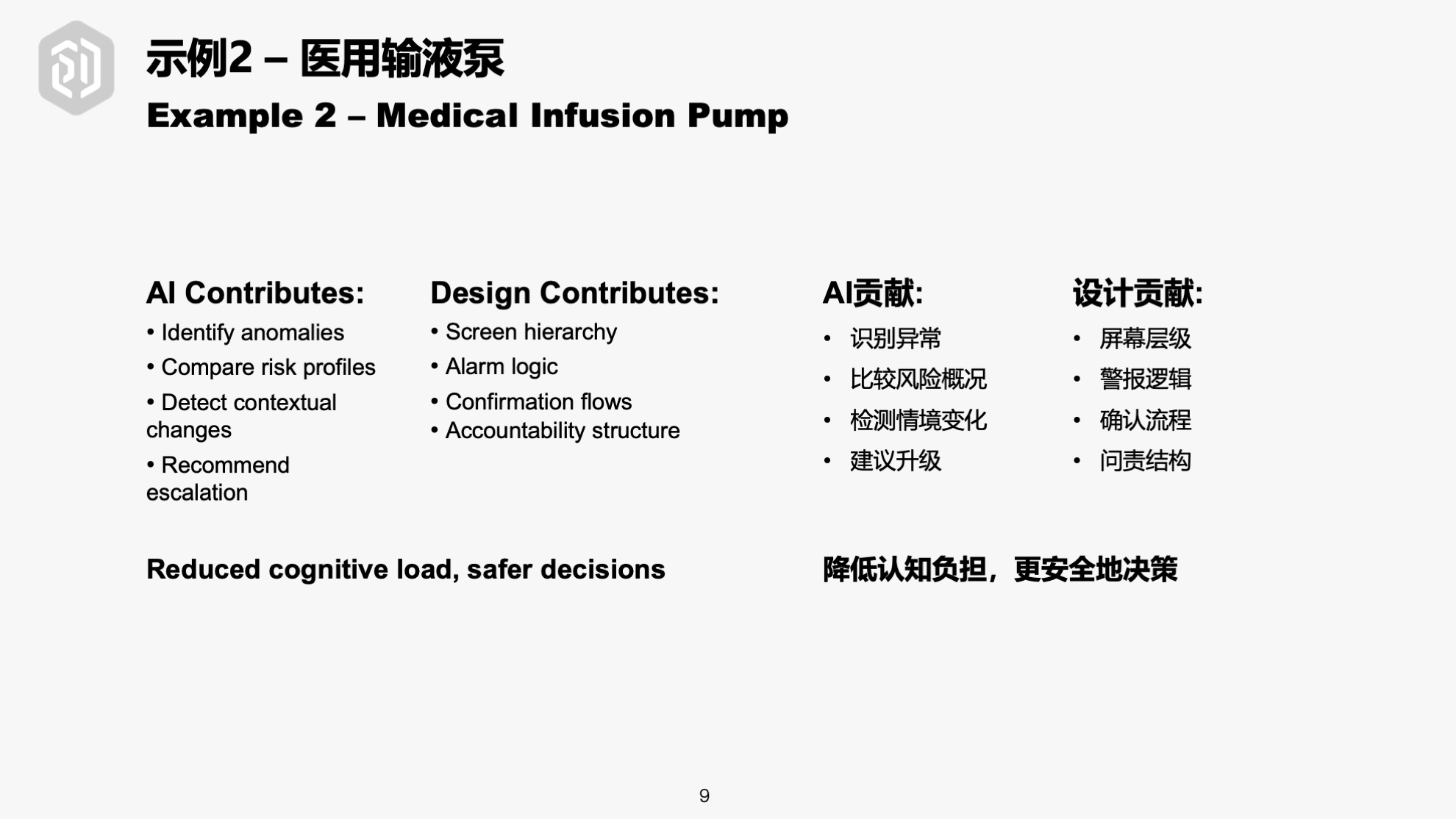
此时,人工智能和设计的区分再次有用起来。人工智能能够识别异常情况、将患者状况与风险模型对比、发现需要关注的行为规律、建议医护人员保持警惕或升级处理流程。但医护人员面对的,不是抽象的算法,而是具体的屏幕层级、警报逻辑、确认流程,以及一套压力工作场景中必须信任的操作界面。
这里就是设计可以贡献价值的所在了。
设计决定了哪些信息是核心重点,哪些是次要信息;哪些预警是需要立即处理的,哪些只是徒增工作压力;设计决定这套系统是支撑医护人员快速、安全地做出决策,还是只会增加他们的认知负担。
我们不妨想象一下这套系统实现场景感知后的状态:夜间医护人员人手不足时,警报的意义会发生变化;面对高风险患者时,默认的工作流程可能不再适用;而对于常规病例,过度灵敏的预警系统可能只会制造更多无效信息。人工智能能够检测到这些语境变化,而设计则决定了这些变化如何被呈现:不同的的信息层级、不同的警报结构、不同的确认与覆盖流程。
设计还界定了权责边界:护士可以直接执行哪些操作?哪些操作需要更高层级的授权?哪些功能始终归属于专业的操作界面?
由此可见,人工智能贡献了分析、检测与建议,而设计贡献了清晰、节奏更适配、逻辑更易懂,构建起一个可用可被信赖的体系。
这不是事后的美学修饰,而是在高风险场景中,对 “安全” 本身的设计。
Now let us move to the hospital.
A traditional infusion pump is a bounded device. It is programmed directly by a clinician. Its intelligence is limited, its interface is local. Its logic is relatively fixed. In that state, design focuses on the form of the device and the clarity of the interface: button shape, screen hierarchy, handle placement, alarm audibility, and the basic ergonomics of use under pressure.
Then the device becomes networked. It can connect to hospital systems, use structured drug libraries, work across different ward types, and participate in a broader informational environment.
This is where the distinction again becomes useful. Artificial intelligence may identify anomalies, compare patient conditions against risk profiles, recognize patterns that deserve attention, and recommend caution or escalation. But clinicians do not encounter an algorithm in the abstract. They encounter a screen hierarchy, an alarm logic, a confirmation sequence, and an interface they must trust under pressure.
That is where design matters.
Design determines what information is primary and what remains secondary. It determines which warning is actionable and which simply adds stress. It determines whether the device supports rapid and safe decision-making or merely generates more cognitive load.
Now imagine that system becoming context-sensitive. At night, with fewer staff, the meaning of an alarm may be different. For a high-risk patient, a default workflow may no longer be appropriate. For a routine case, an overly aggressive warning system may create more noise than value.
Artificial intelligence may detect these contextual changes. Design determines how they are expressed. A different information hierarchy. A different alarm structure. A different pattern of confirmation and override.
And design also determines accountability. What can the nurse do directly? What requires another level of authorization? What remains in the professional layer of the interface?
So again, artificial intelligence contributes analysis, detection, and recommendation. Design contributes clarity, pacing, explanation, and a usable structure of trust.
That is not an aesthetic afterthought. It is the design of safety in a high-consequence environment.
10
第三个案例比较简短,却在某些方面更具启发性。在养老照护领域,存在的问题不仅是功能需求,还包括在场。
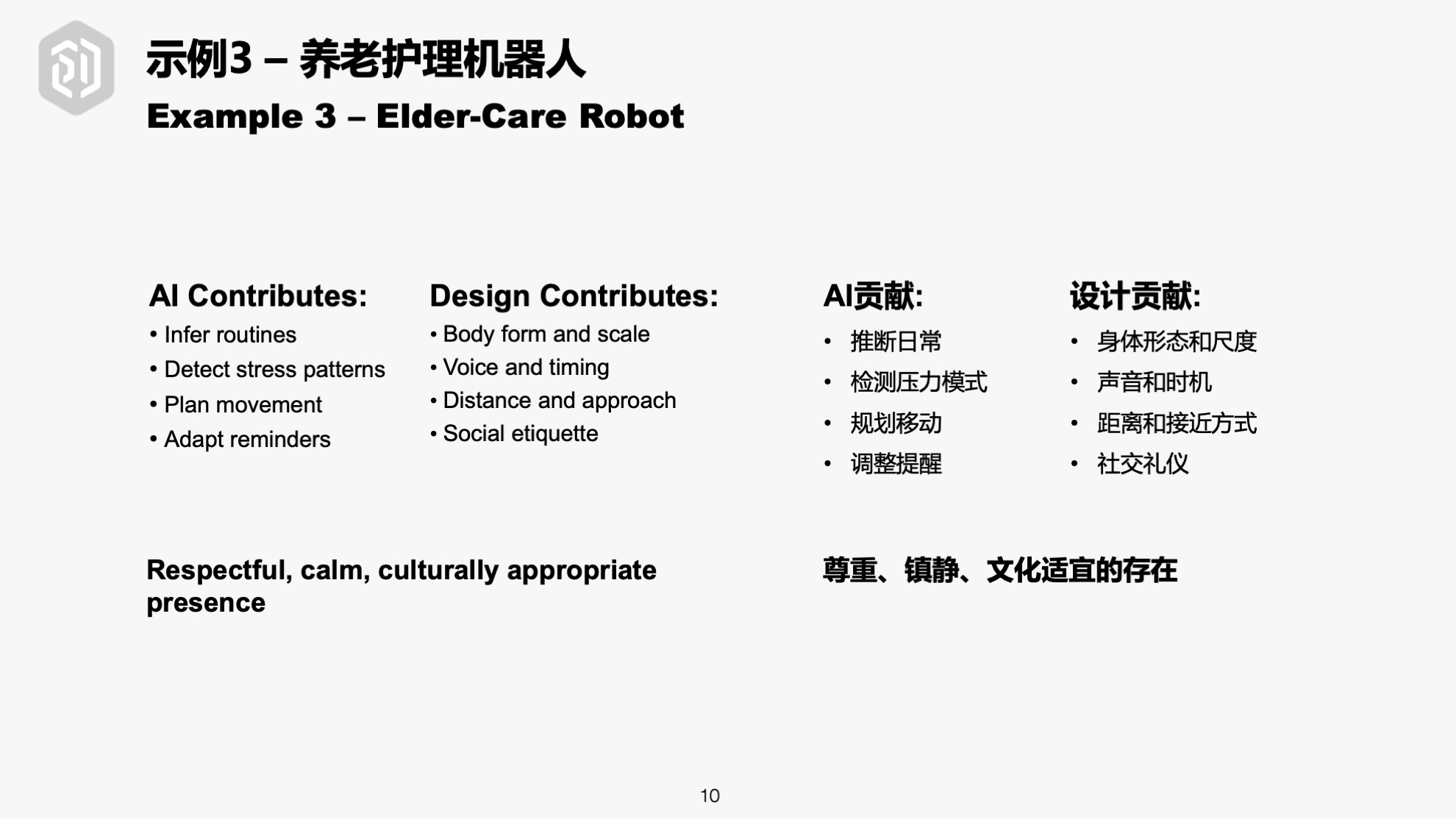
一款简单的辅助设备,会向所有人传递相同的信号;一款更先进的机器人,能够差异化设置提醒、语音、路线与流程;而一个互联互通的照护环境,还能增加状态监测、日程规划与自适应支持功能。但核心问题并非系统是否具备智能,而是这种智能是否从社会与文化的角度来说是妥当得体的。人工智能能够推断老人的生活习惯、检测异常的静止状态、识别情绪压力、规划移动路线、根据时间与场景调整提醒方式。
而设计,则决定了这种智能如何采取社会形态。
机器人的机身形态、尺寸大小、与使用者的距离、靠近的速度、语音特征、响应时机、屏幕显示方式,以及传递关注或不打扰信号的能力,都由设计界定。
当系统感知到老人在夜晚产生焦虑情绪时,设计可以将这种判断转化为更柔和的灯光、更缓慢的移动、更轻柔的语音与更简洁的语言;当检测到有家人来访时,设计可以让机器人适当后退、调整机身角度、降低屏幕的视觉存在感,切换为低干扰的社交角色;当机器人需要重新规划走廊的行进路线时,设计则决定了它如何向周围的人传递这一意图。
可见,人工智能再一次贡献了感知与适应,而设计则贡献了在场、礼仪规范和可解读性。在养老照护场景中,这一点具有决定性意义。因为智能不是因为精准就会被接受,只有当它让人感受到尊重、平和、易懂,且与场景妥当匹配时,才能真正被认可。
通过这三个案例,我想提出最终的观点:如果这是人工智能的发展方向,那么设计教育也应该是这个方向。我们需要的,不仅是会使用人工智能工具的毕业生,更是能够塑造场景、让人工智能有效发挥价值的设计师。
My third example is shorter, but in some ways more revealing.
In elder care, the issue is not only function, it is presence.
A simple assistive device can deliver the same signal to everyone. A more advanced robot can vary reminders, voices, routes, and routines. A connected care environment can add monitoring, scheduling, and adaptive support.
But the key question is not simply whether the system is intelligent. It is whether that intelligence is socially and culturally appropriate. Artificial intelligence may infer routines, detect inactivity, recognize stress patterns, plan movement, or adapt reminders to time and circumstance.
Design determines how that intelligence takes social form.
The body of the robot. Its scale. Its distance from the user. Its speed of approach. Its voice. Its timing. Its screen behavior. Its ability to signal attention or non-interruption.
If the system infers evening anxiety, design may translate that into softer light, slower movement, quieter speech, and simpler language. If it detects a family visit, design may tell the robot to withdraw slightly, angle its body differently, reduce the visibility of its screen, and shift into a less interruptive social role. If it replans its path through a corridor, design decides how that intention is communicated to others around it.
So once more, artificial intelligence contributes sensing and adaptation. Design contributes presence, etiquette, and interpretability. And in care settings, that is decisive. Because intelligence is not accepted simply because it is accurate. It is accepted when it feels respectful, calm, understandable, and appropriate to the setting.
These examples lead to my final point.
If this is where AI is going, then this is also where design education must go. We need more than graduates who know how to use AI tools. We need graduates who can shape the contexts in which AI can act well.
11
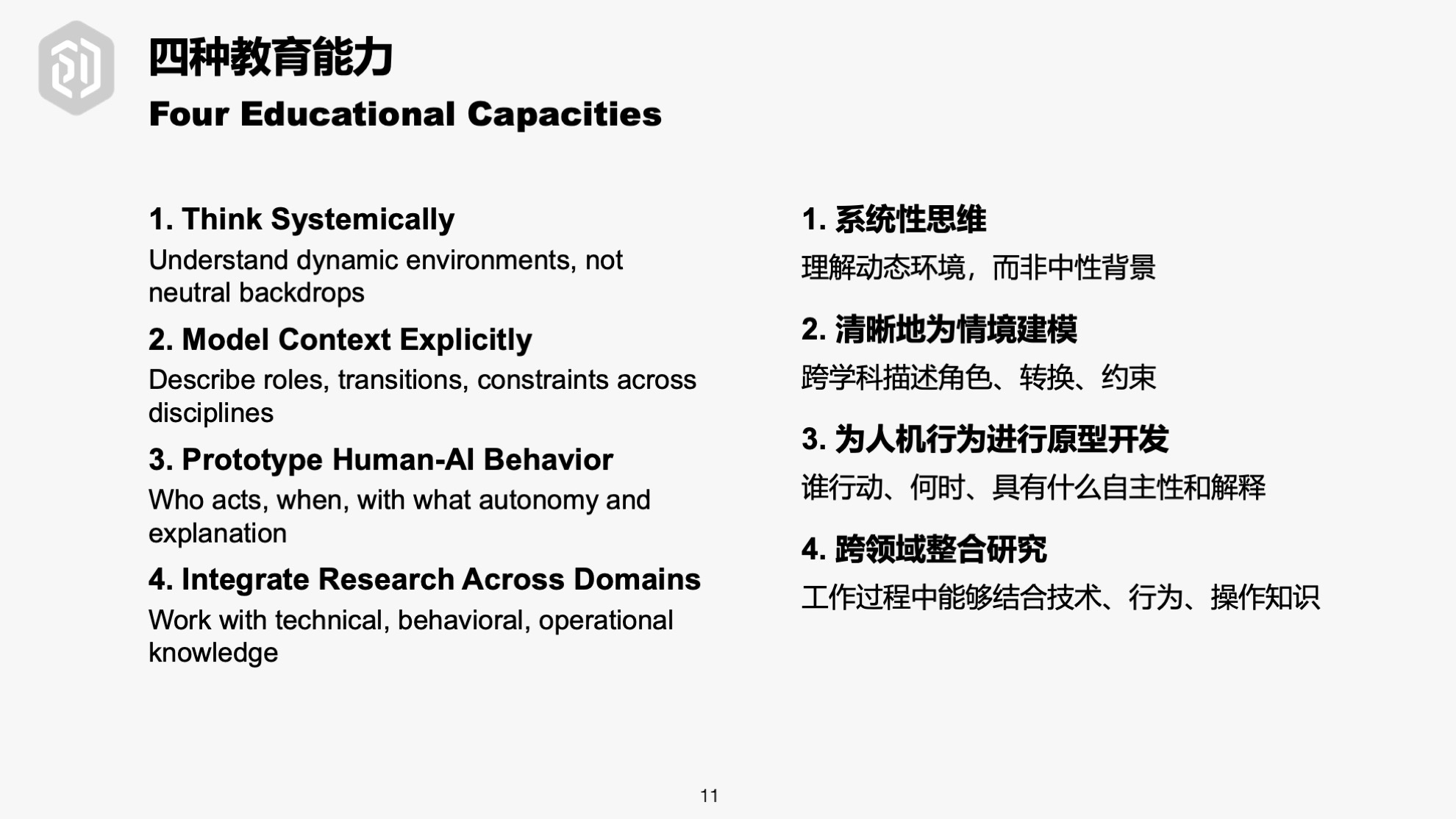
这要求至少四种核心能力:
第一,系统思维能力。能够理解工厂、医院、照护环境都是动态的系统,而非孤立产品的中立背景。
第二,场景具象化能力。能够清晰阐述并构建场景的模型,不能仅停留在泛化的共情或用户旅程描述,而是要将角色、过渡、权限、约束、例外与状态,形成为可跨学科共享的具体形态。
第三,人机协同行为原型开放能力。不仅会使用人工智能工具建模产品与界面,更能设计人机协同的行为模式,思考核心问题:谁来执行操作?何时执行?具备何种程度的自主性?有怎样的逻辑解释?是否有干预与覆盖的可能?
第四,跨领域研究与整合能力。设计越来越依赖于我们将技术、行为与运营知识融合的能力。尤为重要的是,设计师还必须具备伦理思考与道德坚守的能力。
在南科大设计学院,这越来越成为我们未来的方向。我们需要培养这样的设计师:能够在设计判断与技术协作之间流畅切换,能够为场景感知型人工智能,设计形态、界面、交互方式与整体系统。
That requires at least four capacities.
First, they must be able to think systemically. They need to understand that factories, hospitals, and care environments are dynamic systems, not neutral backdrops for isolated products.
Second, they must be able to articulate and model context explicitly. It is not enough to speak broadly about empathy or the user journey. They must be able to describe roles, transitions, permissions, constraints, exceptions, and states in forms that can be shared across disciplines.
Third, they must be able to prototype human-AI behavior, not only use AI to model objects and screens. They need to ask: who acts, when, with what degree of autonomy, with what explanation, and with what possibility of override?
Fourth, they must be able to conduct and integrate research across domains. Design increasingly depends on our ability to work with technical, behavioral, and operational knowledge together. Very importantly, they must be able to work with ethics and moral grounding.
At SUSTech School of Design, that is increasingly the direction we will pursue. We need to educate designers who can move fluently between design judgment and technical collaboration, and who can work on forms, interfaces, interactions, and systems for context-sensitive AI.
12
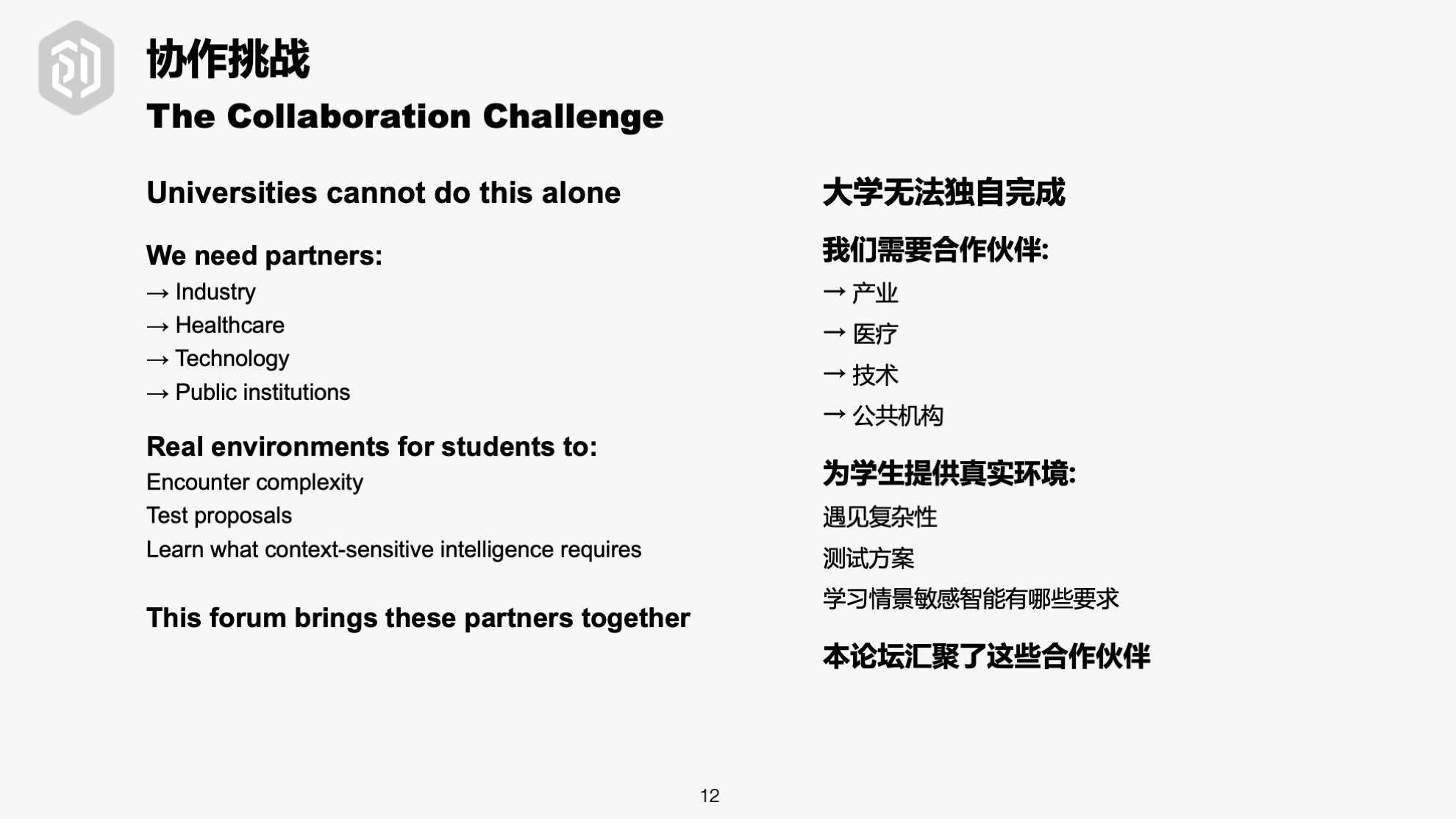
但这项事业,并非高校能够独自完成。我们需要来自产业、医疗、科技与公共部门的合作伙伴,需要真实的应用场景,让学生直面复杂性、检验设计方案,真正理解场景感知型智能的核心需求。
这也是本次论坛的价值之一:它汇聚了能够共同推动这一进程的各类机构。
最后,我想用本次活动的主题语言作结语。人工智能拓展了系统的能力边界,而艺术智能,则决定了这些系统在人类体验中该是什么样。
如果我们从设计的视角理解艺术智能,就会发现,它的价值并非在技术成型后进行装饰,而是让智能在具体场景中产生真正的意义 —— 让智能变得清晰易懂、值得信赖、能够自适应、恰当得体。
我们未来的核心优势,不仅来自更强大的模型,也来自对场景工程学的深刻把握。而这,正是设计的价值所在,也是在技术快速迭代的环境中,设计的持久价值。
如果我们能重视并践行这一理念,粤港澳大湾区不仅能成为先进制造中心,更能成为引领艺术智能与人工智能通过设计深度融合的高地 —— 在形态、界面、交互中实现新一代场景感知型系统。
从这个意义上说,设计智造大奖远不止是一个奖项,更是一个平台:发掘、展示并推动设计、人工智能、教育与产业之间,我们当下亟需的深度协作。我的发言到此结束,谢谢大家。
But universities cannot do this alone. We need partners in industry, healthcare, technology, and the public sector. We need real environments in which students can encounter complexity, test proposals, and learn what context-sensitive intelligence actually demands.
And that is one reason this forum matters. It brings together exactly the kinds of institutions that could build that next stage together.
So let me close in the language of this event. Artificial intelligence expands what systems can do. Artistic intelligence helps determine what those systems should be like in human experience.
If we understand artistic intelligence through design, then its contribution is not to decorate technology after the fact. Its contribution is to make intelligence meaningful in context — to make it legible, trustworthy, adaptive, and appropriate.
Our next advantage will not come only from more powerful models. It will also come from a better grasp of context engineering. And that is where design matters. And it is of lasting value in a rapidly changing technology environment.
If we take that seriously, then the Greater Bay Area can become more than a center of advanced manufacturing. It can become a leading place where artistic intelligence and artificial intelligence are brought together through design — in the forms, interfaces, and interactions of a new generation of context-sensitive systems.
In that sense, DIA is more than an award. It is a platform for identifying, exhibiting, and advancing the kinds of collaborations we now need between design, AI, education, and industry.
Thank you.
部分来源:中国设计智造大奖
编辑:赵怡然
审核:李旭