
Jun 17. 2026 - Latest News
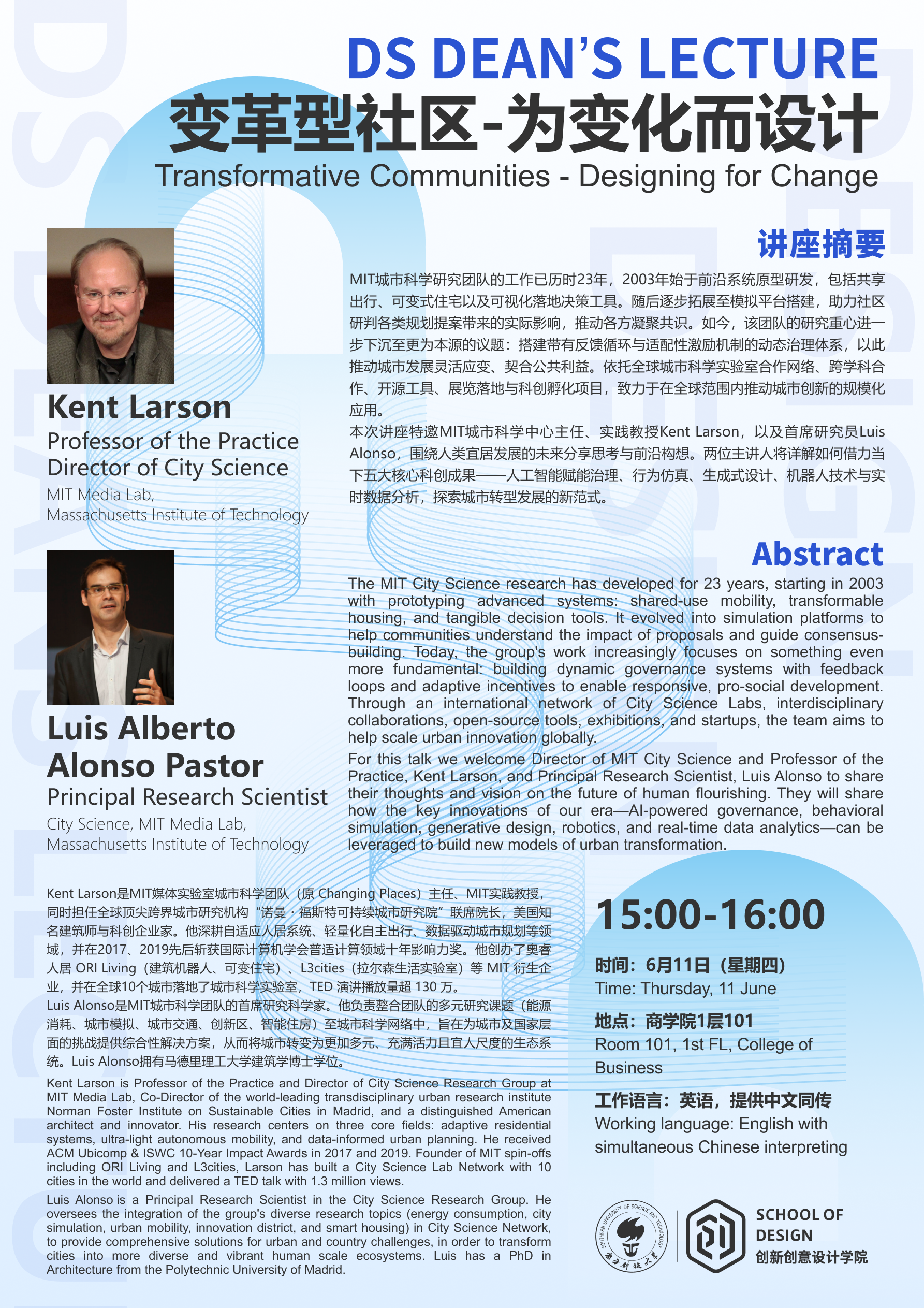
On June 11, the School of Design at Southern University of Science and Technology (hereinafter referred to as the School) hosted the DS Dean's Lecture in Room 101 of the Business School. The lecture featured Kent Larson, Professor of the Practice and Director of the City Science Center at the MIT Media Lab, and Luis Alberto Alonso Pastor, Principal Research Scientist, who shared their work around the theme "Transformative Communities - Designing for Change."
In this lecture, the two speakers' presentations covered shared mobility, transformable housing, behavioral simulation, generative design, and real-time data analysis, seeking to respond to a central question: as cities continue to face changes in technology, the environment, and social structures, how can we design communities and governance systems that adapt to change, guide collaboration, and generate public value?
Before the lecture began, Dean Thomas Kvan welcomed the two speakers on behalf of the School. He noted that the DS Dean's Lecture continues to invite scholars and practitioners from around the world to share their work with the School, and that design has never been a narrow proposition. Rather, it is a comprehensive practice that concerns society, technology, ethics, and real-world implementation. He also introduced the global research network of the City Science Center at the MIT Media Lab and reflected on his long-standing exchange with Kent Larson, observing that Larson's research continues to move into greater depth while steadily expanding its real-world impact. With these remarks, the discussion on future communities and urban transformation officially began.
Transformative Communities
-- Kent Larson
As the first speaker of the lecture, Kent Larson spoke on “Transformative communities.” Drawing on recent research by the City Science Center at the MIT Media Lab, he showed how the team uses algorithms, simulation models, tangible interaction platforms, and tools for institutional design to rethink the question of how communities respond to change. In his view, design is not the shaping of a single spatial object, but an ongoing process of calibration: understanding reality through data, testing proposals through simulation, and embedding the results into governance mechanisms.
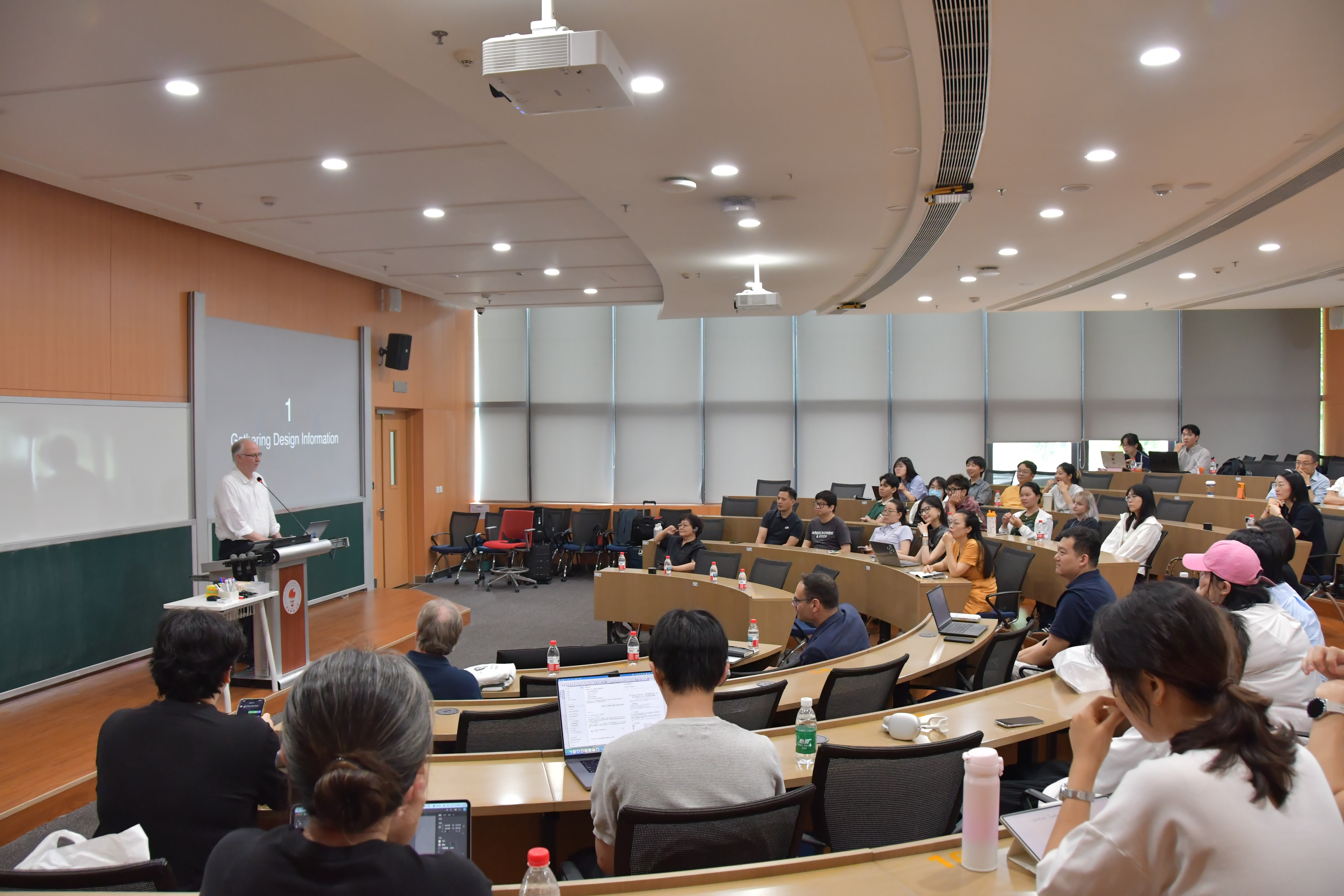
From Thought Experiment to Community Simulation
Kent opened with a “thought experiment.” He looked back at the postwar reconstruction plan for a village in France after World War II: Le Corbusier had proposed an entirely new master plan for the village, but the proposal was ultimately rejected by residents. Through this case, Kent raised a question: if a designer today worked with a group of AI agents, could they propose a plan that would be more acceptable to the community?
In this scenario, the team asked different agents to gather images, textual materials, and historical records related to the project, transform ideas that had remained at the sketch level into 3D models that could be computed and simulated, and generate "synthetic resident profiles" with different ages, occupations, and daily habits. Through these simulations, researchers could observe how different groups move among buildings, streets, and public facilities, how they make decisions, and what problems they encounter in daily life.
For Kent, what truly matters is not only whether a proposal “looks reasonable,” but whether it can actually be used effectively in everyday life. Through simulation, the team found that many residential areas in the original proposal were too far from the central square, and that the retail layout could not support frequent daily activities. In other words, many grand formal ideas do not necessarily work well in real life.
Based on these analytical results, the team further used generative methods and genetic algorithms to test more possibilities and compare how different layouts performed in terms of community vitality, accessibility, and functional coordination. Even so, Kent noted that urban design proposals directly generated by AI at the current stage still tend to feel “rigid,” and remain far from creating places that are truly vibrant and humane. This also means that humans must remain in the design process for quite some time.
Turning Complex Urban Issues into Discussable Objects
Kent then introduced CityScope, a system that the City Science Center has developed over many years. It is an interactive platform that combines physical models, data projection, dashboards, and simulation programs, with the goal of turning abstract and complex urban issues into objects that the public, researchers, and decision-makers can understand and discuss together. Whether in Kendall Square near MIT or in cities such as Shenzhen and Hamburg, the team has used similar methods to help participants directly manipulate parcels, density, mobility, and functional arrangements, and immediately see the impacts brought by changes in a proposal.
In Kent's view, effective public participation does not hide complex technologies, but translates them into sufficiently intuitive modes of interaction. Compared with complex interfaces that require a high threshold of use, low-threshold physical media such as blocks allow people to engage immediately and more readily stimulate face-to-face discussion. This insight makes CityScope not only an analytical tool, but also a design medium for public deliberation.
Reorganizing Community Relations Through Mobility and Housing
At the case level, Kent also shared several studies around mobility and housing. In transportation, the team has tried to rethink the question of “who owns the street.” In housing, they have explored how transformable micro-units can support richer living scenarios within limited space. For him, responding to community issues cannot rely only on expansionary construction or single-point technological updates. More importantly, it requires reorganizing the relationships among space, resources, and daily life at the community scale.
Bringing Design into the Governance Loop
After showing how design and technology can produce new proposals, Kent emphasized that these proposals must ultimately enter the realm of governance in order to truly take effect. Through examples such as carbon-emissions models, housing supply, community amenities, and zoning systems, he explained that many urban problems remain imbalanced over the long term, not because they lack a single technical solution, but because institutions lack effective feedback mechanisms.
Therefore, Kent’s goal is not to design a “perfect community” once and for all, but to establish a dynamic governance framework closer to an ecosystem: continuously sensing current conditions through data, evaluating the effects of interventions through simulation, and then adjusting housing, employment, services, and public-resource allocation within the community through policies and incentives. Only when these links form a closed loop can cities truly acquire the capacity to respond to change.
The City Science Network of Affiliated Labs
--Luis Alberto Alonso Pastor
In the second part of the lecture, Luis Alberto Alonso Pastor spoke on “The city science network of affiliated labs,” expanding the perspective from a single project to the question of how the City Science Center collaborates. He explained that the City Science Network has established collaborative nodes in multiple cities around the world. Yet the most important aspect of this network is not for MIT to export a fixed answer outward, but to work with local governments, industry, academia, and communities to form horizontal collaborations around concrete problems.
Responding to Global Problems through Collaborative Networks
Luis emphasized that many cities today face similar global challenges, but truly effective solutions must first be highly localized. In other words, the team is not trying to build a tool that can be universally applied everywhere, but to work in different cities with those who best understand local contexts in order to find interventions suited to specific communities. For them, technology, data, and AI are only means; the ultimate goal is always to improve people's quality of life.
Under this logic, the City Science Network is more like a continuously growing collaborative framework. On the one hand, different cities share experience, methods, and research capacity; on the other hand, each lab is deeply embedded in local realities and works around the most urgent issues in its own context. This approach of “global problems, local responses” also forms the core starting point of Luis’s lecture.
The Andorra Case: When Data Begins to Answer Real Governance Questions
Luis used the long-term collaboration in Andorra to explain how this approach works. Although Andorra is a small country with a modest population, it has a highly complex governance structure and a large volume of tourism. Because it has both the “complexity of a country” and the “scale of a city,” the City Science Center has been able to test many methods related to policy, infrastructure, and public services there.
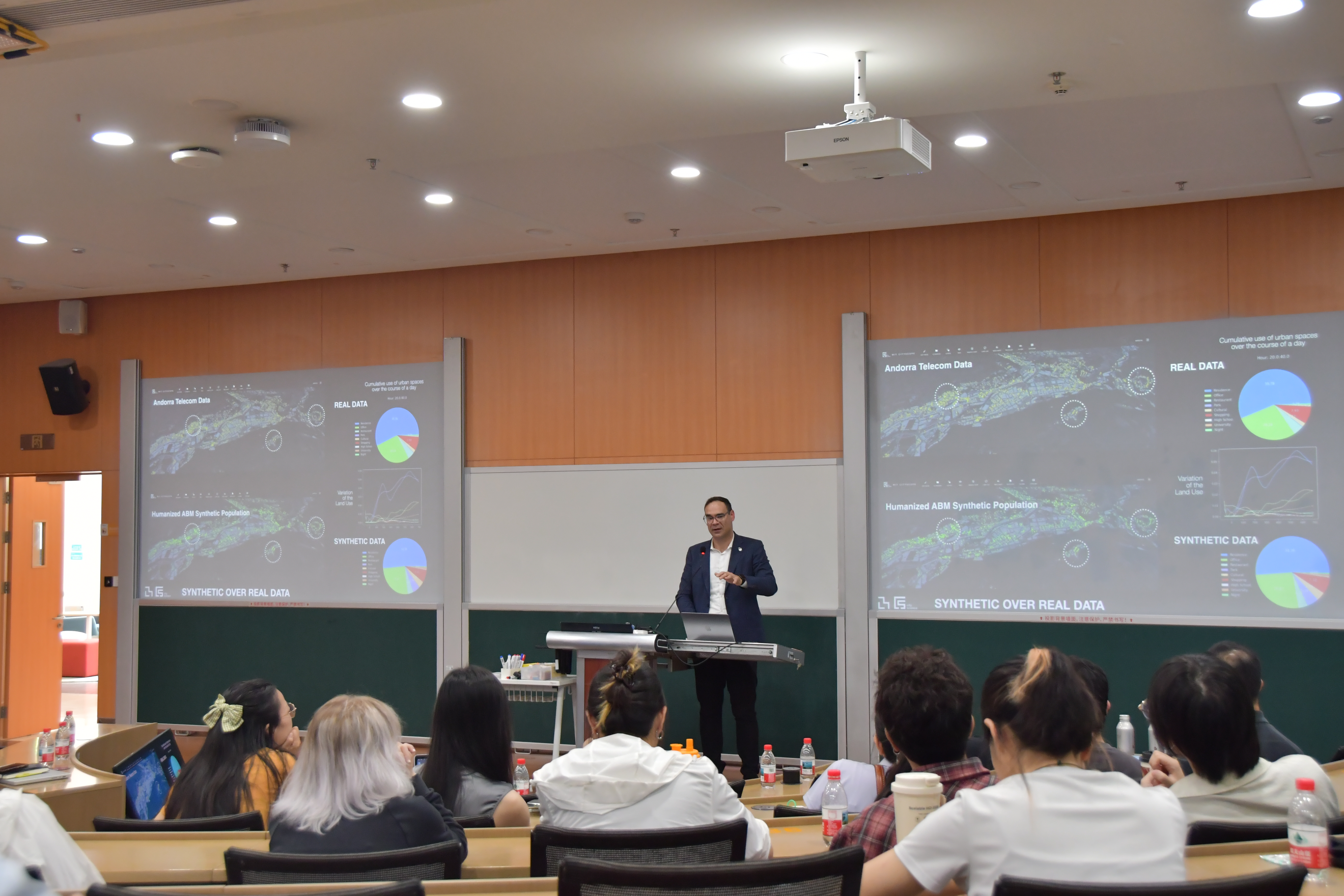
In the Andorra project, the team first obtained high-quality telecommunications data and, under strict conditions of data security and anonymization, tried to understand how tourists move within the country. A single data source alone is not enough to support truly useful judgments, so the team further combined telecommunications data with social platforms, energy data, and sensor data from educational contexts, gradually building an urban portrait closer to real life. Through these models, the team could not only identify mobility patterns among different tourist groups, but also help the government understand the relationships among major events, tourism structures, and energy consumption.
Luis particularly noted that what truly matters in this type of research is not "how much data we have," but whether the data can be translated into decision-making tools that governments can use. For example, by linking tourist behavior with energy consumption, the team helped further improve the accuracy of local energy forecasting models. During the COVID-19 pandemic, the accumulated data and modeling capacity also helped Andorra identify key mobility patterns more quickly and support more refined public decision-making.
From Real Data to Synthetic Data
When discussing methodological development, Luis also highlighted the direction of “synthetic data.” Real data is certainly valuable, but not every city can obtain data as complete as Andorra's. For this reason, the team has begun to use basic sensor data and large language models to generate “synthetic data” that approximates real behavioral patterns, and to apply it to mobility simulation, congestion prediction, and scenario testing.
In his view, the significance of this approach lies not only in its value as a technical substitute, but also in enabling more cities to conduct analysis and simulation. Furthermore, when these simulated subjects gain stronger learning and interaction capabilities, researchers can even pose questions to the entire “synthetic population” to understand how different groups perceive safety, convenience, or the quality of public space. In this way, models that once leaned toward quantitative statistics begin to extend into more nuanced dimensions of urban experience.
Bringing Innovation to Overlooked Places
Another very important part of Luis's lecture was his attention to "informal settlements" and vulnerable communities. He pointed out that much of the world's future urban population growth and urban expansion is likely to occur in the Global South, with a significant share concentrated in areas with insufficient resources and incomplete infrastructure. For the City Science Center, this does not mean that these places lack innovation. On the contrary, such communities often have already developed highly flexible self-organizing mechanisms around housing, water supply, transportation, and livelihoods.
Therefore, the team tries to collaborate with these communities rather than simply treating them as objects to be governed. Whether in informal settlements in Latin America or in projects related to vocational-skills certification and educational transformation, the team is exploring how to help people who have been excluded from formal systems gain more possibilities to enter the formal economy and public-service systems. In Luis's view, this kind of collaboration grounded in lived reality is precisely one of the most valuable parts of urban innovation.
Beyond “Smart Cities”: Putting People Back at the Center
At the end of the lecture, Luis argued that when we talk about cities today, we should no longer stop at labels such as “smart city” or “green city.” Instead, we should ask further how to truly put people back at the center of the city. Whether through global lab networks, cross-city collaboration, real-time data, synthetic data, or new technologies and education projects, these efforts are ultimately not only about making cities “more efficient,” but about allowing people in cities to have a better quality of life.
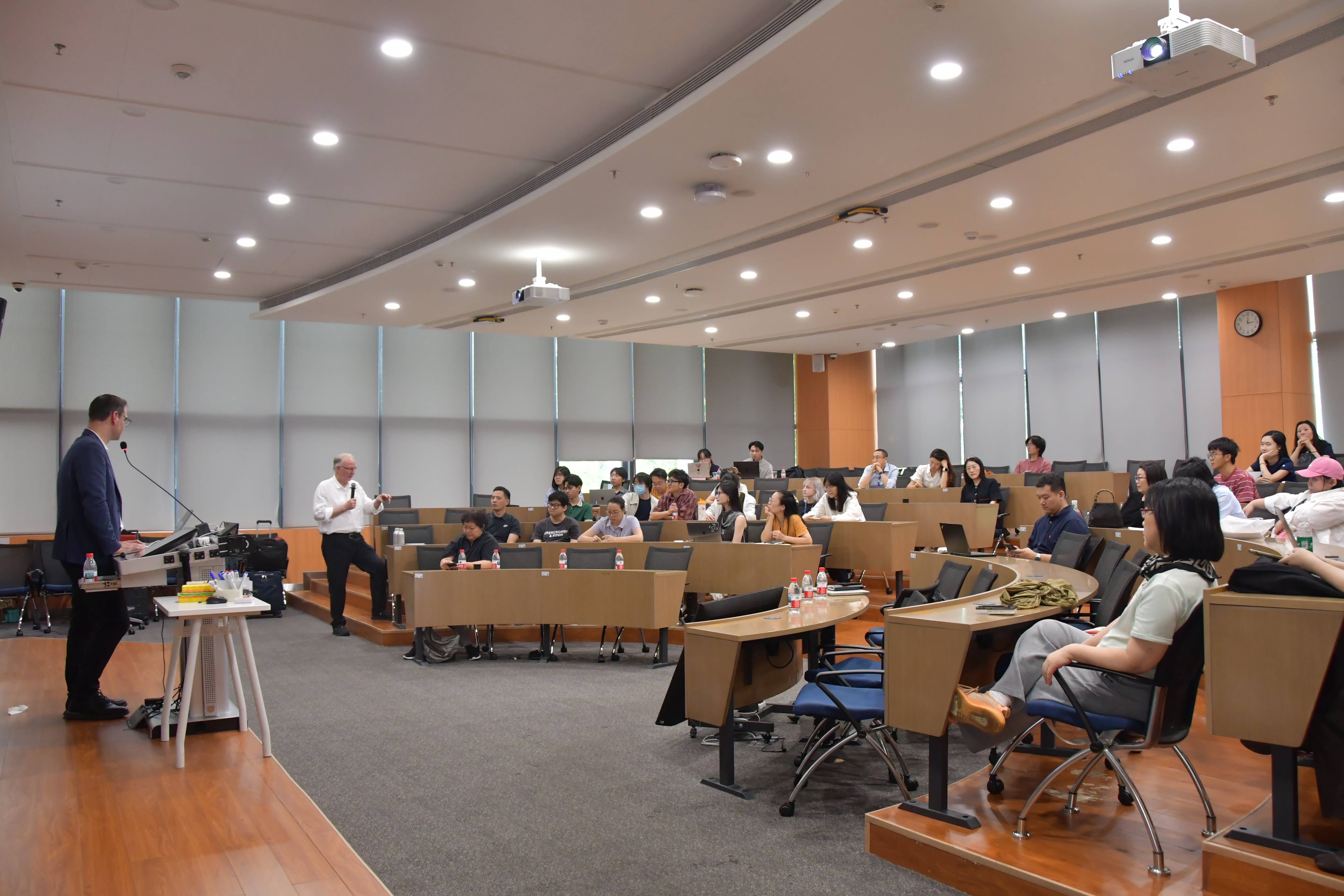
After the lecture, a Q&A exchange was held on site. Kent and Luis had a brief discussion with faculty and students around questions such as how nature can be incorporated into urban science and sustainable-development frameworks, and how physical AI and sensor systems can respond to the needs of residential and office spaces.
This lecture was not only about how technology enters the city. More importantly, it reminded us to rethink the object of design in the face of constantly changing social and environmental conditions. The object of design is no longer only space itself, but the continuously evolving relationships between people, between people and systems, and between communities and governance. Perhaps “designing for change” means moving from certainty toward openness, and from one-time solutions toward mechanisms that can continue to grow.
.png)
Jul 7. 2023 - Latest News
Jul 6. 2026 - Latest News
Nov 29. 2023 - Latest News