
Oct 12. 2026 - Latest News
From August to September 2026, the School of Design at Southern University of Science and Technology (SUSTech) partnered with the Nanshan iPark Party Member Guidance Center for Emerging Sectors Development to present the “Pro-Talk” AI Product Innovation Workshop Series. Four School faculty members and one industry expert led five sessions on Affective Human-AI Interaction, Digital-Physical Twin Making, Embodied Intelligence and Soft Tactile Sensing, Well-being-Centered Product Design, and Full-Stack AI Workflows. The series brought them into dialogue with business leaders, product managers, designers, R&D professionals, and participants from the Guidance Center, attracting a cumulative attendance of more than 150.
The series prompted us to look more closely at the effectiveness of university-industry exchange: how research and methods from universities are understood and questioned by industry, and how such exchanges can offer company professionals new ways to think about products and technologies while giving the School a clearer view of industry needs.
Political scientists Allison Bramwell and David A. Wolfe, in their study of the relationship between the University of Waterloo and regional economic development, offer a framework for evaluating and continually strengthening such exchanges. They argue that a university contributes to a regional economy through far more than commercializable research outputs. Its role also works through four interrelated mechanisms: generating and attracting talent; providing formal and informal R&D support to companies; connecting the region to frontier knowledge through academic networks; and embedding itself in the local community while cultivating innovation networks. The study notes that everyday consultation, the movement of people, and face-to-face interaction all facilitate knowledge transfer. Students take classroom knowledge into companies and bring business problems back to campus, a process that also shapes corporate innovation.
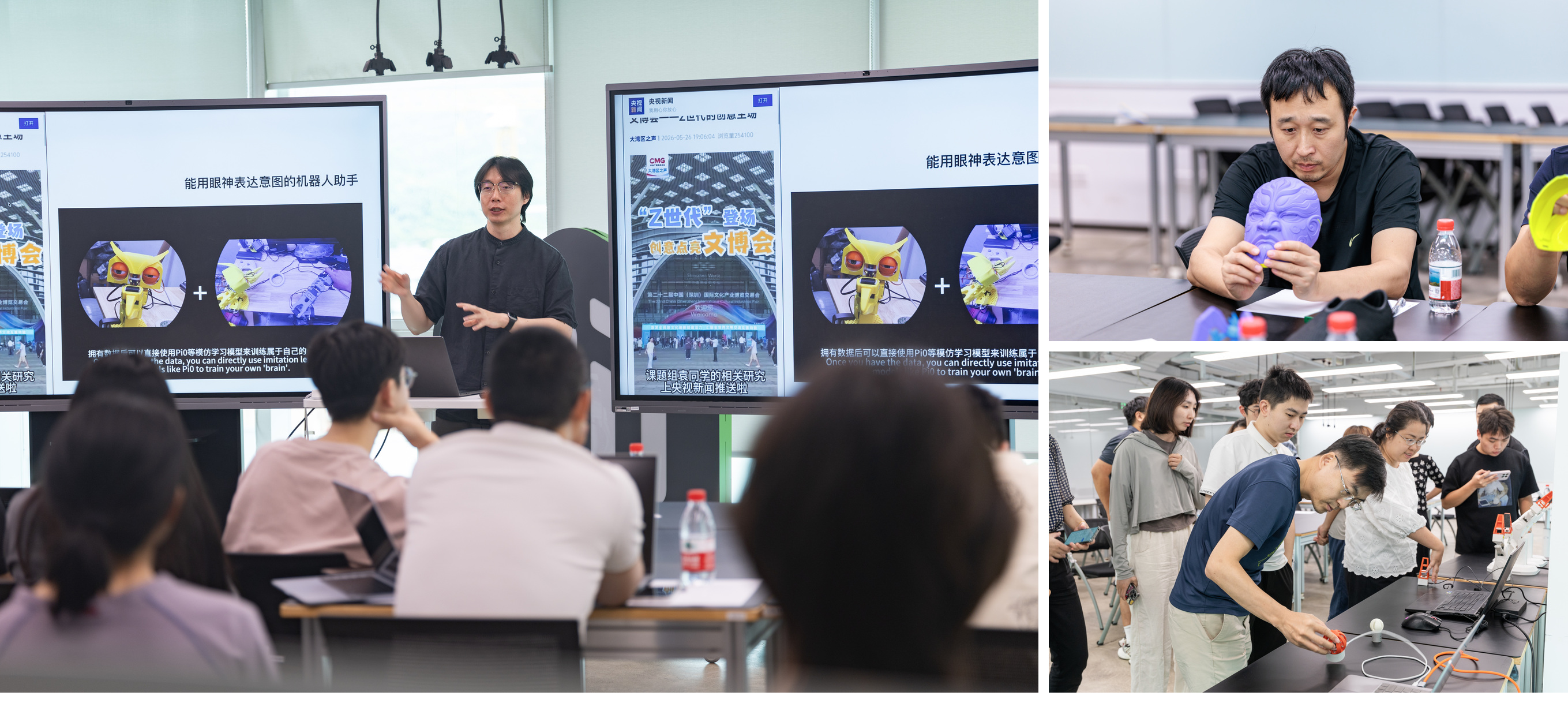
From left: sessions on affective human–AI interaction, 3D printing, and embodied intelligence with soft tactile sensing
When Research Meets Industry
Across five workshops, topics ranged from frontier technology and product validation to organizational collaboration, demonstrating several ways in which interdisciplinary research across design and technology can engage with industry practice. AN Pengcheng began with affective sensing, AI responses, and user trust, exploring how intelligent products might build more natural relationships with people. Professor HAO Liang brought 3D-printed samples, prompting discussion of materials, structures, costs, and prototype validation. WAN Fang presented work on grasping and sensing with soft robotic fingertips, while participants asked about miniaturization, computing power, and real-world robotic applications. LI Xueliang used a digital plant and a soft companion device as examples to encourage reflection on psychological experience beyond product function. HUANG Mingjie first invited participants to share challenges from their own businesses, and the group then explored how AI could be integrated into workflows and team collaboration. Through case studies, physical exhibits, technical demonstrations, and open discussion, the series brought perspectives from production, education, and research into the same room, allowing participants to compare them directly and engage in more concrete and in-depth discussions of technology application.
Most company participants said these exchanges affected how they thought about real products and business challenges. Many described their main takeaway as a re-examination of the problem: when working with AI, they first needed to clarify their role, business objective, and criteria for judgment; in product design, they needed to translate abstract ideas such as emotion and experience into design criteria that could support evaluation and trade-offs. The workshops allowed participants to step outside day-to-day work, look at problems through new lens of university research, and take new concepts and methods back to their roles for further testing in real product development and business practice.
“The value of the workshops did not necessarily lie in providing answers that could be applied immediately. Their greater value was in renewing our perspectives and prompting us to rethink the questions we ask.”
—A business leader from a company in the park who attended several sessions
“A large part of what I gained came from the practical perspective on product design. It encouraged designers accustomed to familiar routines to rethink how design can actively shape the user experience. I found that genuinely refreshing.”
—A designer who participated in the workshop series
“This workshop changed how I think about applying psychological research to products. A commercial product cannot solve every issue uncovered by research, so trade-offs are unavoidable. Accurately understanding and articulating emotional needs can help us make better decisions.”
—A workshop participant with a design background
Conversations with company participants also led faculty to reconsider how their research connects with industry. For research findings to move into companies, academic concepts need to be translated into knowledge that companies can understand, assess, and apply. In turn, questions about cost, supply chains, markets, validation, and organizational coordination add new perspectives to research and teaching. When companies bring real needs and participants arrive with ongoing projects and prior experience, faculty can respond more directly and identify issues that may develop into student projects, product validation, or collaborative research.
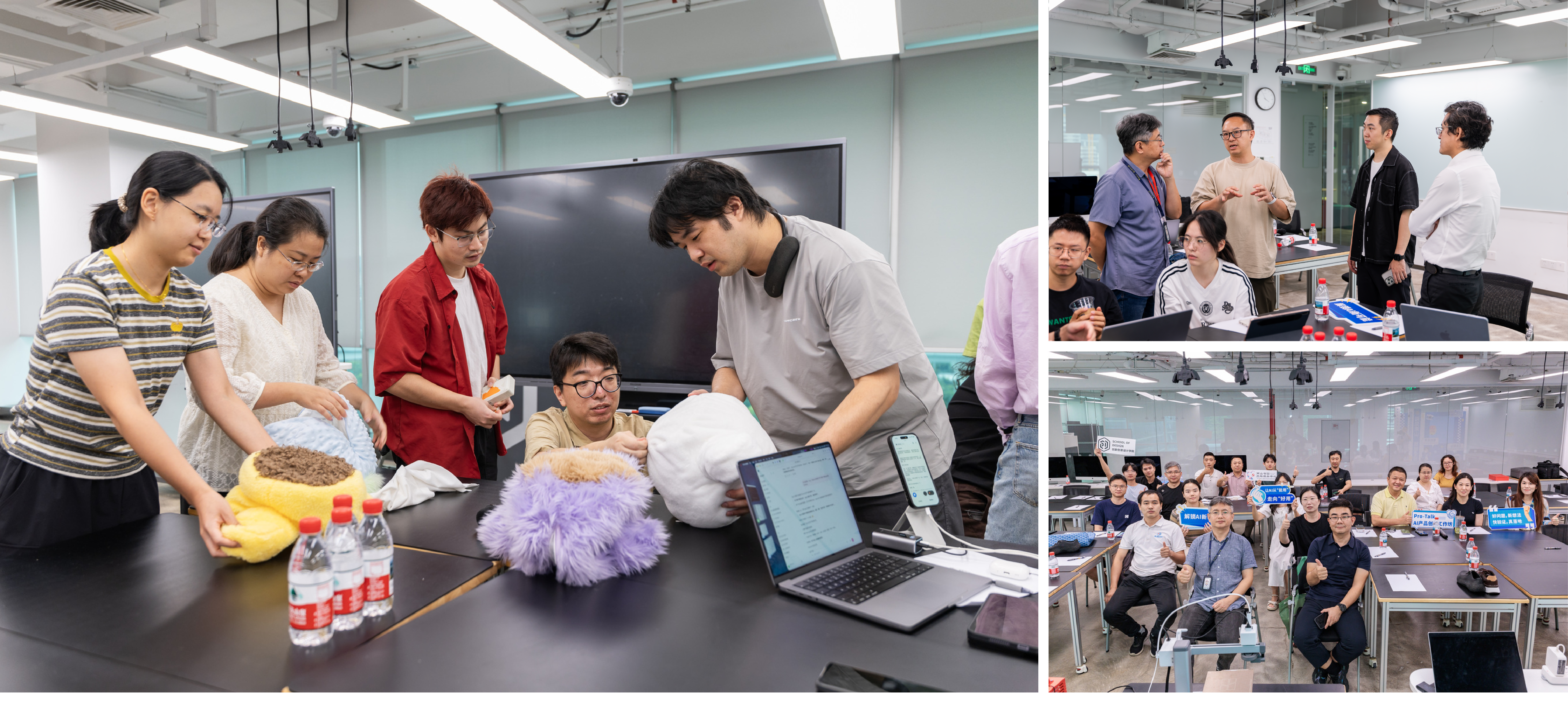
Well-being-Centered Product Design,
and Full-Stack AI Workflows Workshops
Hands-on exploration, participant exchange, and shared learning across the workshop series
From Spatial Proximity to Sustained Connection
Bramwell and Wolfe's study of the University of Waterloo emphasizes that geographic proximity is an important condition enabling universities to contribute to regional development. The SUSTech School of Design is located in Nanshan iPark, where technology companies in robotics, smart devices, sensors, and advanced manufacturing are clustered. The workshops brought researchers, students, and company employees into dialogue around shared questions and laid the groundwork for continued exchange and collaboration.
By approaching AI product innovation through the relationships between people and technology, product manufacturing, interactive experience, and organizational collaboration, the “Pro-Talk” AI Product Innovation Workshop Series opened multiple windows onto the field for professionals across the park. Although the series has concluded, the product ideas, business needs, and professional connections that emerged from the workshops continue. For the School, the initiative not only brought interdisciplinary research in design and technology closer to companies; it also created a window into industry and regional innovation. The connections formed through the series can support deeper interaction among teaching, research, and industry practice, while providing more sustained support for business innovation and regional industrial development.
Reference: Bramwell, A., & Wolfe, D. A. (2008). Universities and regional economic development: The entrepreneurial University of Waterloo. Research Policy, 37(8), 1175-1187.

Jan 6. 2022 - Latest News
.png)
Sep 22. 2023 - Latest News

Jan 6. 2021 - Latest News