
Apr 16. 2026 - Latest News
Introduction
On the morning of March 23, 2026, Thomas Kvan, Dean of the School of Design at Southern University of Science and Technology, was invited to attend the DIA Greater Bay Area Forum on Intelligent Manufacturing at Design Society, Sea World Culture and Arts Center in Shenzhen, where he delivered a keynote speech.
The forum was hosted by the China Academy of Art and China Merchants Culture | Design Society, and co-organized by the Design Intelligence Award, Design Society, Sea World Culture and Arts Center, the Collaborative Innovation Center of Cultural and Creative Design Manufacturing at the China Academy of Art, and the International Design Intelligence Alliance.
The forum was held in conjunction with the touring exhibition “Two AIs: Artistic Intelligence and Artificial Intelligence in Innovative Design.” Centered on the concepts of “artificial intelligence” and “artistic intelligence,” the exhibition explores the collaborative relationship between technological rationality and human creativity in the age of intelligence. Building on this foundation, the forum extended the discussion to examine the reflective process through which artificial intelligence and artistic intelligence converge, interact, and evolve together in an era of technological transformation.
In his speech, Kvan addressed the theme of “design, context, and intelligence,” exploring how the role and methods of design are changing in the age of artificial intelligence. He noted that design has moved from shaping individual products to constructing systems and organizing behaviors within complex and dynamic contexts. While AI can enhance our capacities for perception and prediction, it still has limitations in understanding roles, behavioral intentions, priorities, and norms within specific contexts, and therefore requires design to guide and integrate its application. From this perspective, the speech proposed the idea of “context engineering,” emphasizing that designers can actively construct contexts that allow intelligent technologies to operate effectively in real-world applications and to appear within human experience as clear, trustworthy, and appropriate systems. Drawing on examples from manufacturing, healthcare, and elderly care, Kvan further illustrated the critical role of design in optimizing human-machine collaboration and improving the legibility and reliability of systems. Looking ahead, he also emphasized that design education must strengthen systems thinking and cross-disciplinary integration in order to support the deeper application and development of artificial intelligence across society and industry.
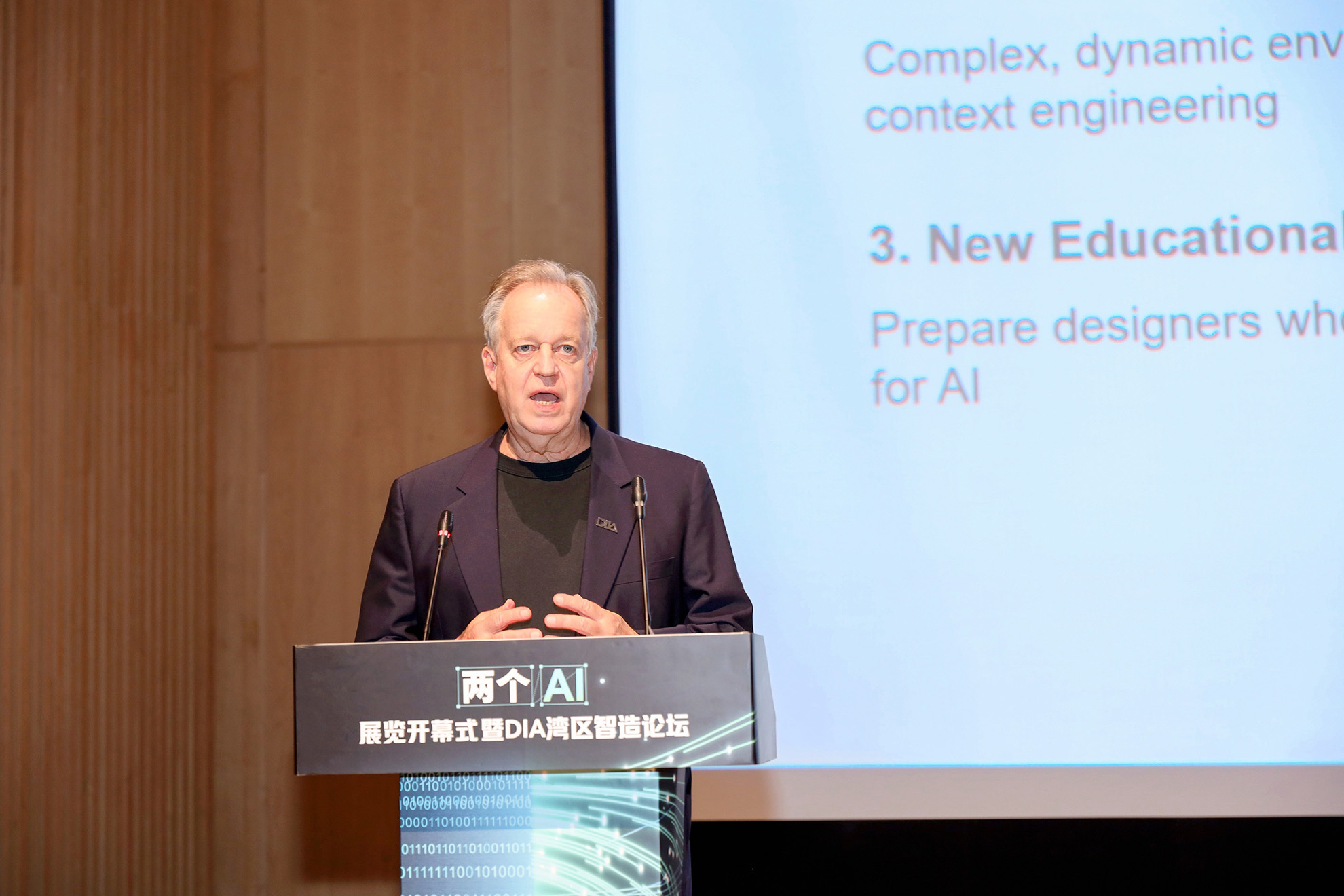
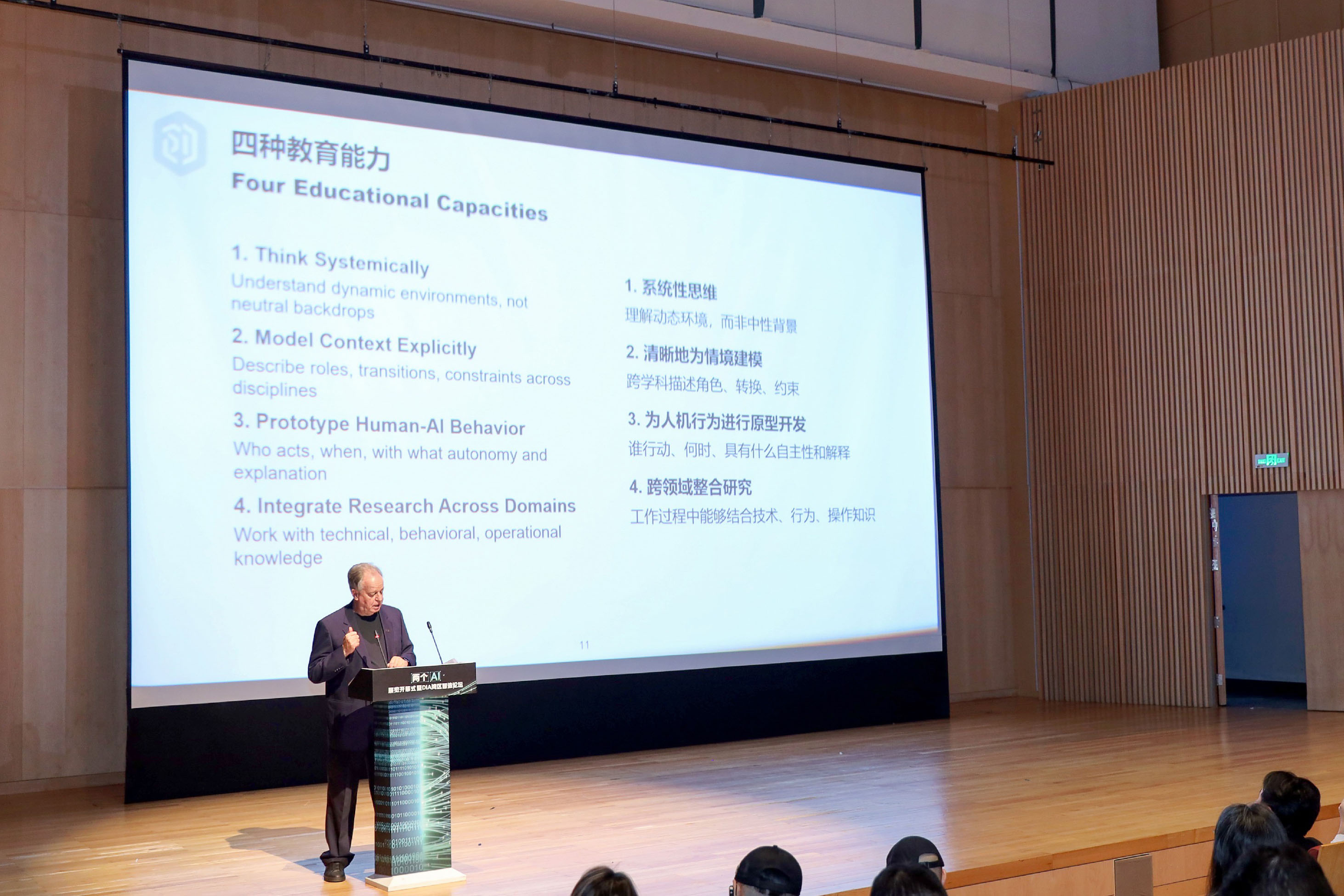
Thomas Kvan, Dean of the School of Design at Southern University of Science and Technology, delivering the keynote speech
The full text of Dean Thomas Kvan’s speech is presented below:
Please cite the source when quoting.
Designing Intelligence in Context
1
Distinguished guests, colleagues, and friends,
Thank you for the invitation to speak today. I am especially honored to join this event, because the Design Intelligence Award has become an important platform for bringing design, technology, and intelligent manufacturing into productive dialogue.
This forum, together with the touring exhibition, makes that role very visible: it asks not only what AI can do, but how design gives it form in society and industry.
2
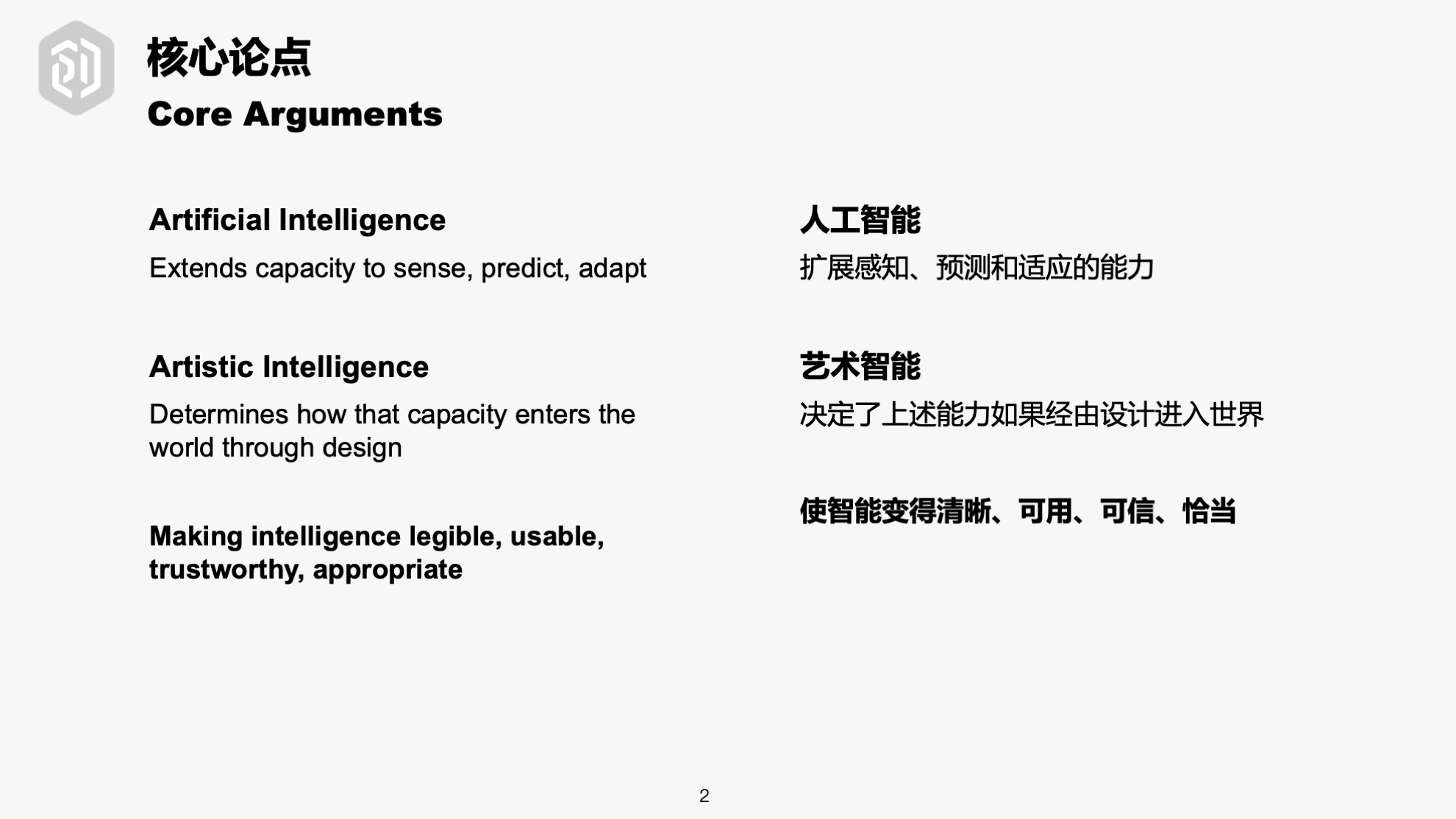
Artificial intelligence increases our capacity to sense, predict, and adapt. Artistic intelligence, as I will use the term today, is the human capacity to give that intelligence form, meaning, and judgment through design.
So if artificial intelligence extends capability, artistic intelligence determines how that capability enters the world: how it becomes legible, usable, trustworthy, and appropriate. As an educator, my focus is how we equip our emerging generations with these capabilities.
That is the theme of my remarks today.
I will start with three claims.
3
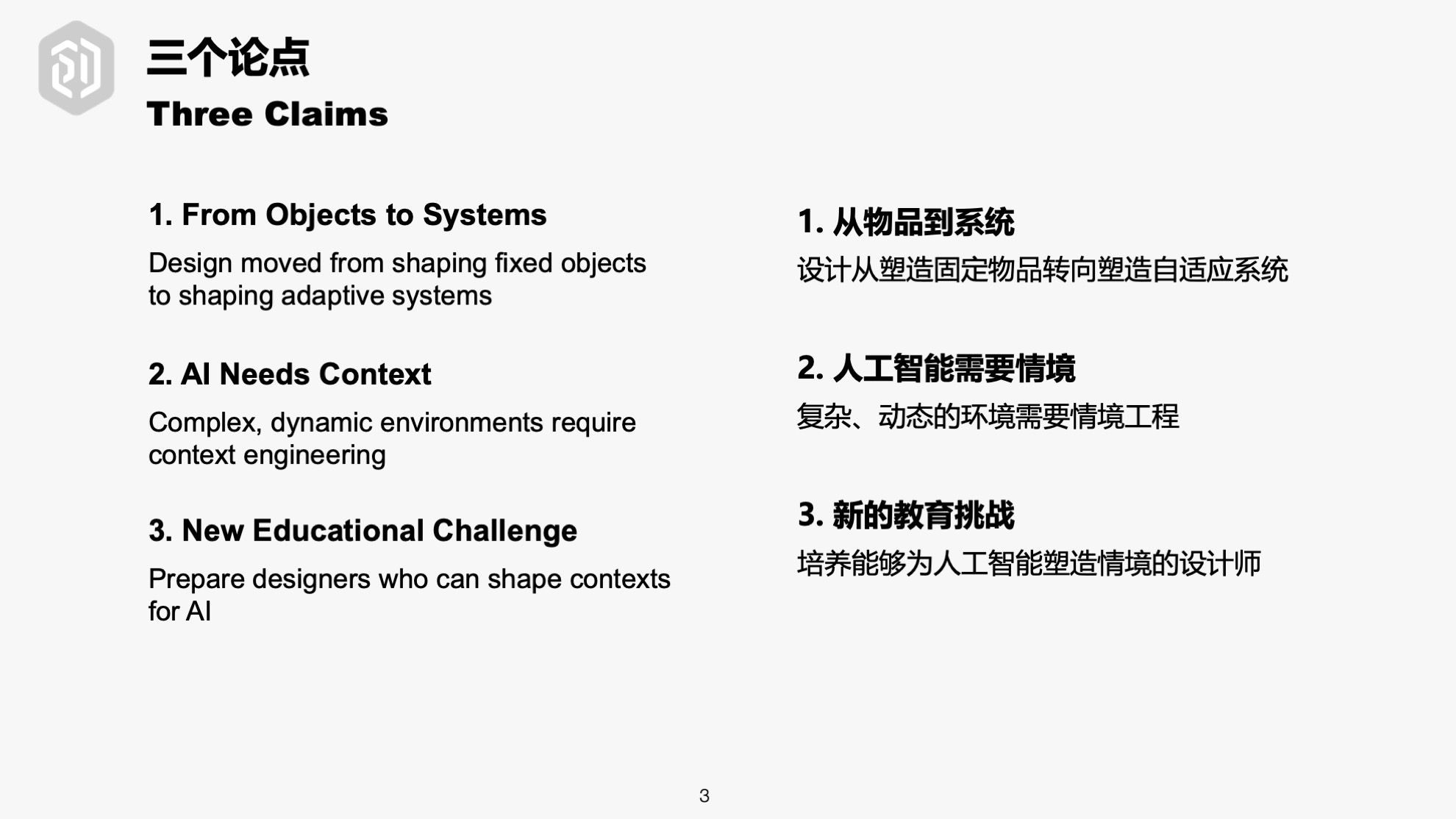
First, design has moved from shaping objects to shaping systems in changing situations.
Second, many of those situations are now complex and adaptive, so AI needs context in order to work well.
Third, this creates a new educational task: we must prepare designers who can practice what I would call context engineering.
Let me begin with a familiar example.
4
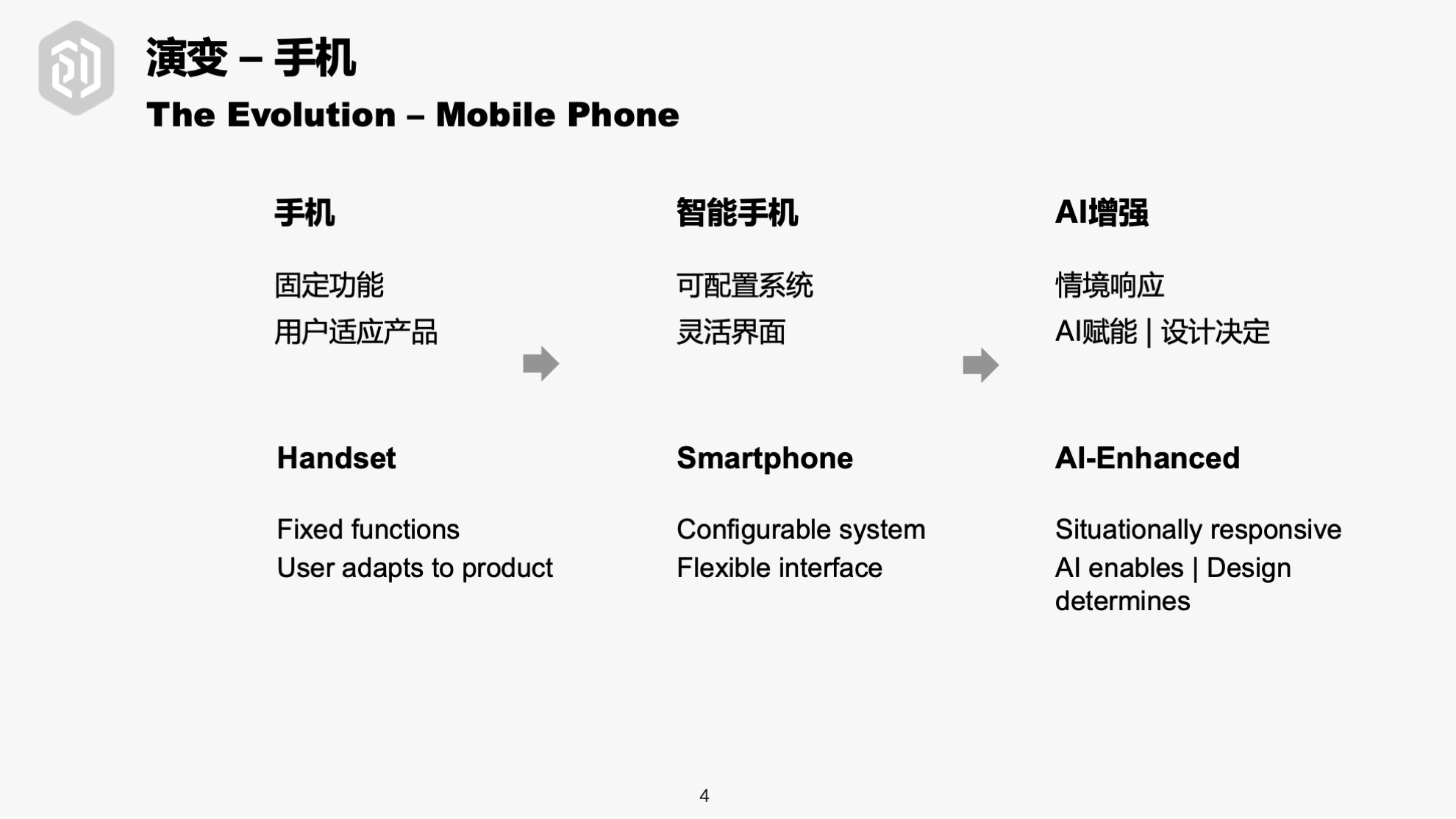
Twenty years ago, the mobile phone was still primarily a handset. It offered a limited set of fixed functions. Its interface was largely stable and the user adapted to the product. In that period, design focused on the object itself: its weight, its feel in the hand, the clarity of its keypad, the legibility of its screen, the precision of its physical interface.
Then the smartphone arrived. Now the product became more open, more configurable, and more layered. Users installed apps, rearranged functions, changed settings, and each device was unique. Design changed as well. Design was no longer only about the coherence of one object. It was also about the coherence of a system: an interface architecture, a visual language, and an interaction model that could support many different configurations without becoming chaotic.
Now AI is changing that device once again. Today the smartphone can learn routines, infer patterns, and respond differently to different circumstances. It can reorder information, propose suggestions, adapt recommendations, anticipate and change behavior according to time, place, and activity.
This makes the role of design more important.
5
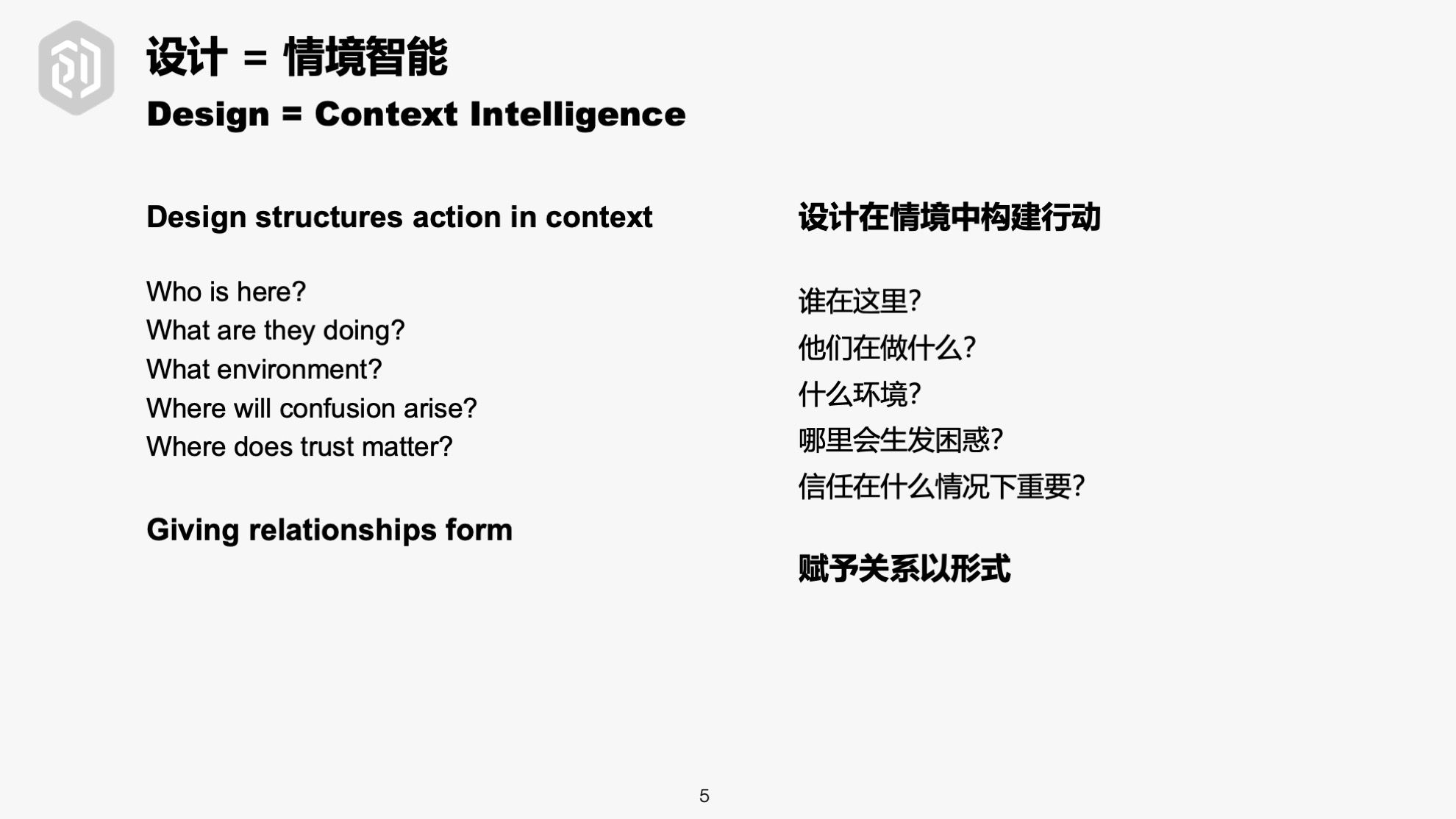
Which information should matter? Which adaptations should happen automatically? Which should remain under user control? How does the system indicate what it is doing, and why? At what point does assistance become intrusion?
These are not only technical questions. They are design questions.
So the first observation is this:
We have moved from designing fixed objects to designing systems capable of varied behavior. Artificial intelligence makes that possible. Artistic intelligence, working through design, determines when and how that possibility becomes valuable.
This leads to a broader point.
At times, especially in public discussion, design is still confused with decoration and mainly a matter of appearance. But, as we know, design is the discipline that structures action-in-context.
A designer asks: who is here, what are they trying to do, what environment are they in, what risks are present, where will confusion arise, and where will trust matter most?
Then the designer gives those relationships form. That form may be physical form, or it may be an interface, a workflow. It may be a spatial arrangement, a visual hierarchy, a sound logic, or a sequence of interactions. In every case, design is doing more than styling an object. It is making a situation intelligible and actionable.
That is why I am comfortable using the phrase artistic intelligence here, provided we understand it carefully.
Artistic intelligence is not the decorative application but grounded in the moral philosopy of aesthetics, a profoundly deep tradition in China. Artistic intelligence is the cultivated human capacity to interpret context, shape meaning, and give emerging forms of intelligence an appropriate presence in the world.
And that capacity is realized through design.
That is also why the exhibition matters. By presenting DIA-recognized works in areas such as embodied AI, the metaverse, and the low-altitude economy, it shows that the meeting of artistic intelligence and artificial intelligence is not abstract; it is already taking material form in emerging domains.
6
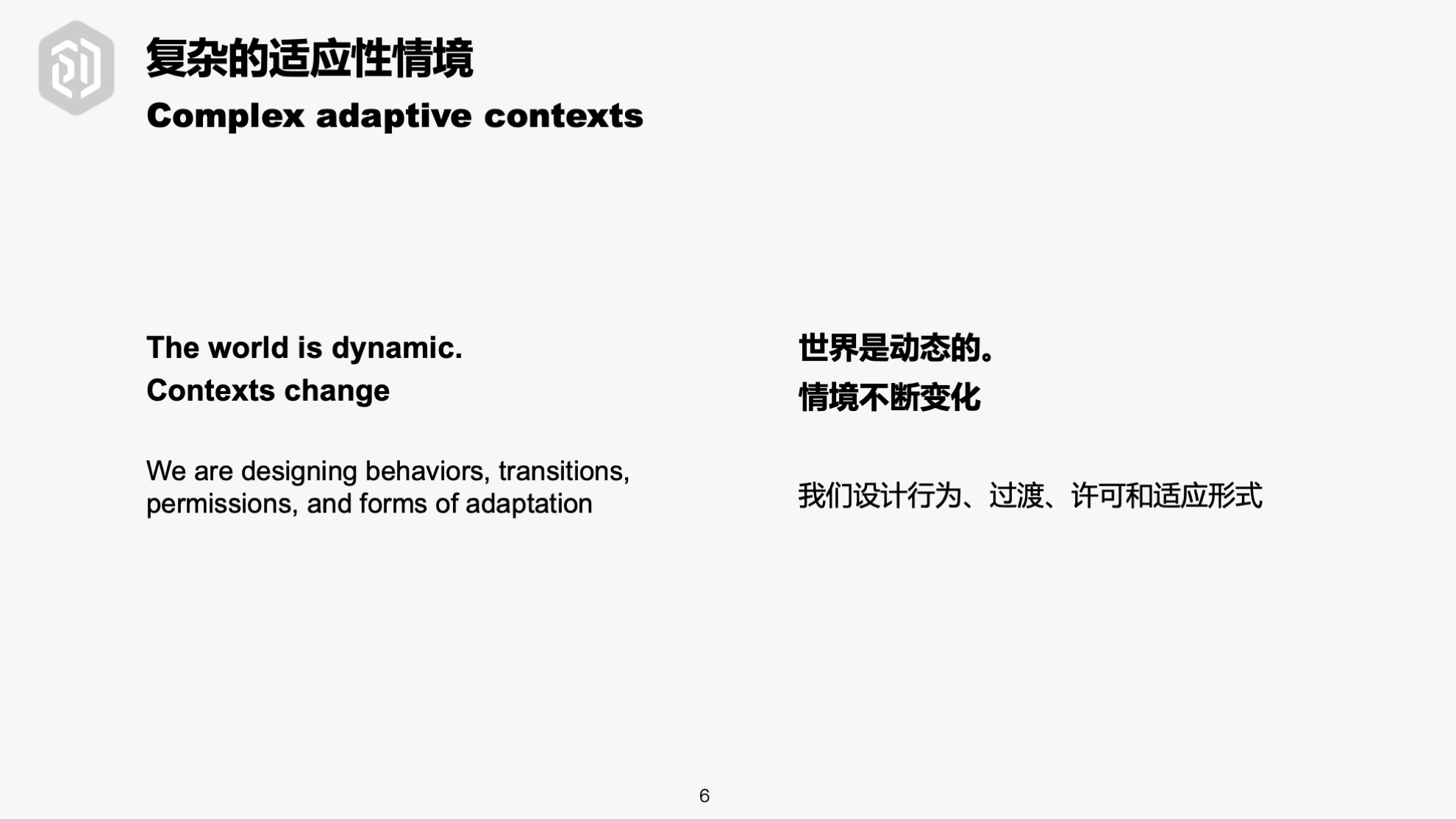
Now, why does this matter so much today? Because the settings in which we are deploying AI are not static. Factories, Hospitals, Cities are dynamic. Conditions change. Small changes in one part of the system can have large effects elsewhere.
In other words, many of the systems we now design for are complex adaptive systems. In such settings, a fixed object or interface is rarely sufficient. A fixed workflow is unusual. So the work of design also changes.
We are no longer only designing products. We are designing behaviors, transitions, permissions, and forms of adaptation. We are designing not only what a system is, but how it changes as circumstances change.
7
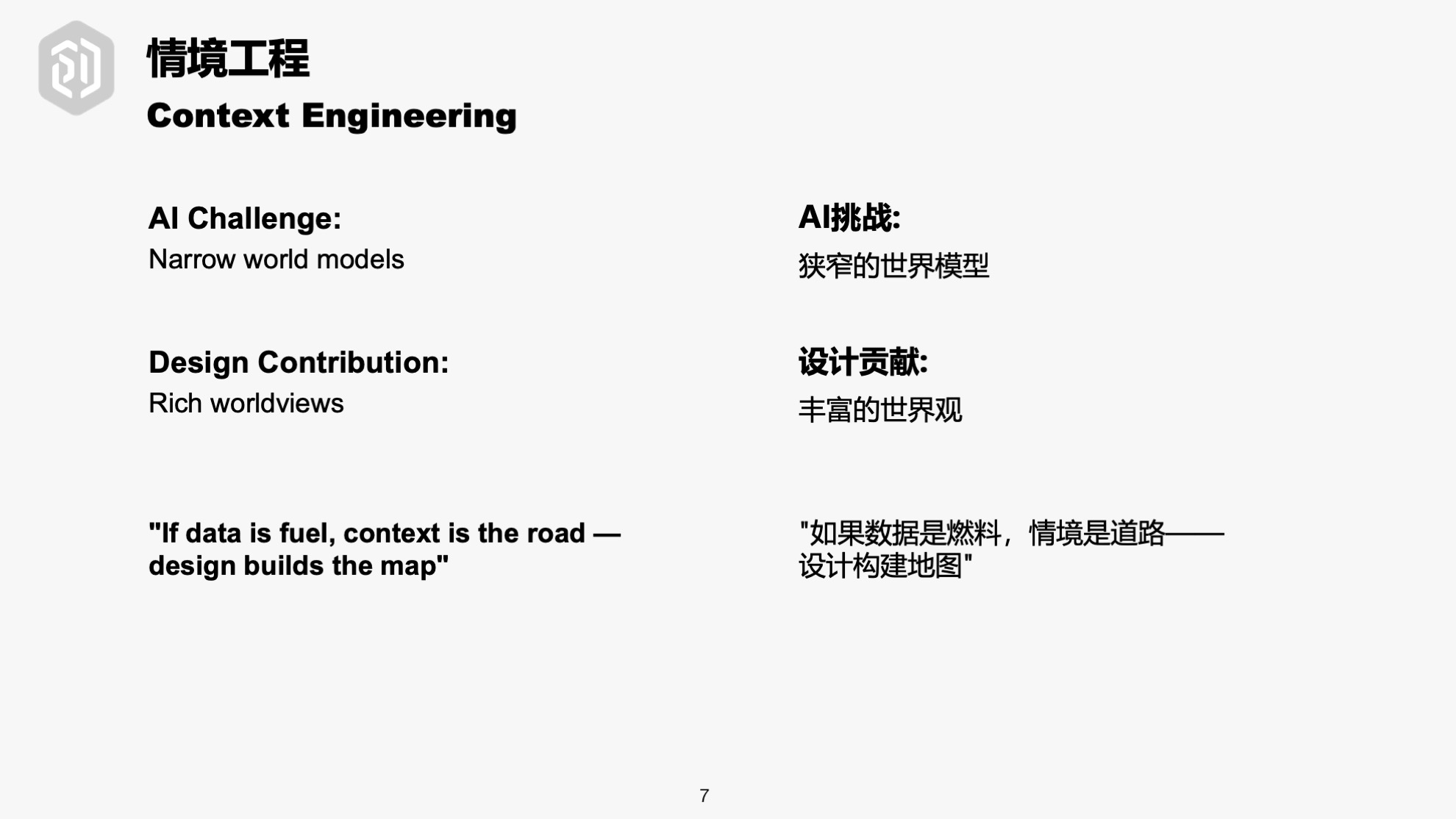
Artificial intelligence is powerful, but it is often weak in context. It can identify patterns in data, but it does not automatically understand roles, intentions, priorities, norms, exceptions, or consequences in the way human practitioners do.
This is where I find the concept of context engineering useful. Already an established technical term in AI engineering, it refers to LLM's context window to improve AI agent performance and accuracy. Today, I want to extend this, so by context engineering, I mean the deliberate work of making situations explicit enough for intelligence to act well within them.
That gap matters. Intelligence isn't just prediction, it is timing, purpose, explanation, and authority. Who is expert or novice? What needs attention now or can wait? When should the system suggest, warn, stay silent, or stop? These contextual judgments fall to designers, who must make them explicit for design, engineering, and operations. If data is the fuel of AI, context is the road. Artificial intelligence may supply power. Artistic intelligence, working through design, helps shape the road on which that power can travel.
Let me now make this concrete through three examples.
In each case, I want to separate clearly what artificial intelligence contributes, and what design contributes. That distinction is important, because otherwise design disappears into a general story about technology.
8
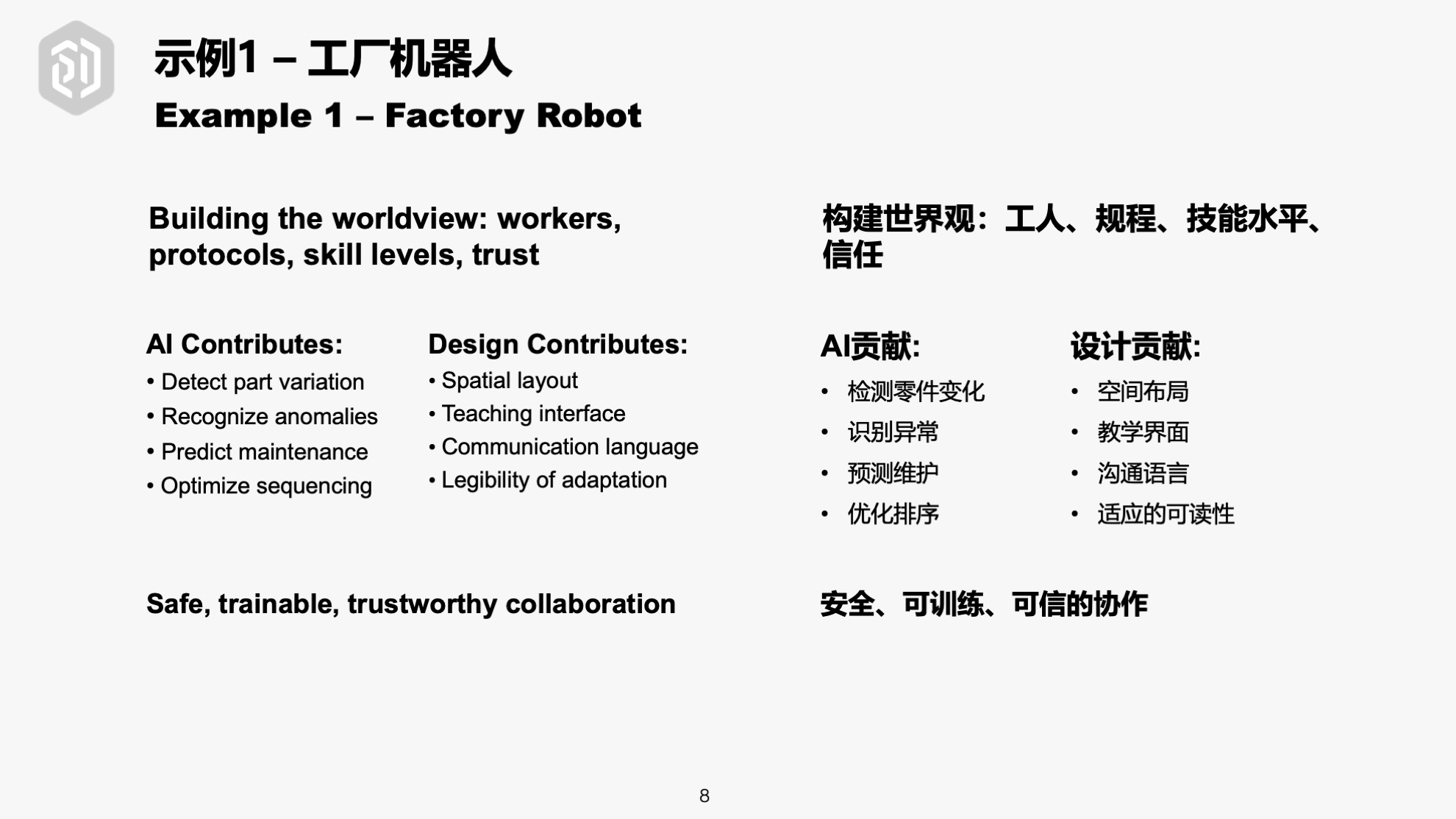
The factory robot is especially relevant today because intelligent manufacturing is at the center of this forum.
Let us begin with the traditional industrial robot. In its classical form, it is a highly capable but tightly bounded object. It works inside a defined cell. It repeats a known sequence. It assumes consistent parts, consistent timing, and a largely frozen environment.
In that setting, design is present, but in a relatively limited way. It shapes the physical reach of the arm, the placement of emergency stops, the structure of the control pendant, the visual coding of warnings, and the thresholds by which a person understands where danger begins.
Now move to the collaborative robot. Here the system becomes more open. The robot may work closer to people, be taught new tasks. It may shift between tools, products, or workflows. The factory cell becomes less fixed, and the interaction between person and machine becomes more important.
At this point, the difference between artificial intelligence and design becomes much clearer. Artificial intelligence may help recognize part variation, detect anomalies, estimate uncertainty, anticipate maintenance, or optimize sequencing. Design determines how those capabilities are embodied in the workcell.
Design shapes the spatial layout: where a worker stands, how a person approaches the cell, how reach, speed, and risk are perceived. Design shapes the teaching interface: whether the robot can only be reprogrammed by a specialist, or whether a trained operator can guide it through demonstration, gesture, or a clear visual workflow. Design shapes the communication language: the light states, sound cues, screen hierarchies, and motion signatures through which the robot communicates readiness, caution, interruption, or invitation.
This is already far more than styling. It is the design of collaboration.
Now take the next step: the context-aware robot in a living factory.
A real factory is not a controlled demonstration. Workers change roles. Skill levels vary. Defect rates rise and fall. Urgent orders appear. Upstream problems affect downstream behavior. Maintenance status changes the meaning of the same action. Artificial intelligence may detect these changes. It may infer that a novice worker is present, that quality has drifted, or that production urgency has increased. But design determines how that intelligence appears and how it is acted upon.
For a novice worker, the interface may become more explicit: larger guidance, clearer sequencing, slower transitions, more obvious confirmation, and motion that reads as careful rather than abrupt. For an expert, the same system may become more compact: fewer prompts, denser information, quicker transitions, and greater freedom of action.
If defect rates rise, AI may register increased uncertainty. Design decides whether that uncertainty becomes alarm, confusion, or useful guidance. Design contributes legibility, coordination, trust, and safe collaboration.
Good AI may improve throughput. Good design makes adaptive automation understandable enough to train, trustworthy enough to deploy, and robust enough for everyday factory use.
9
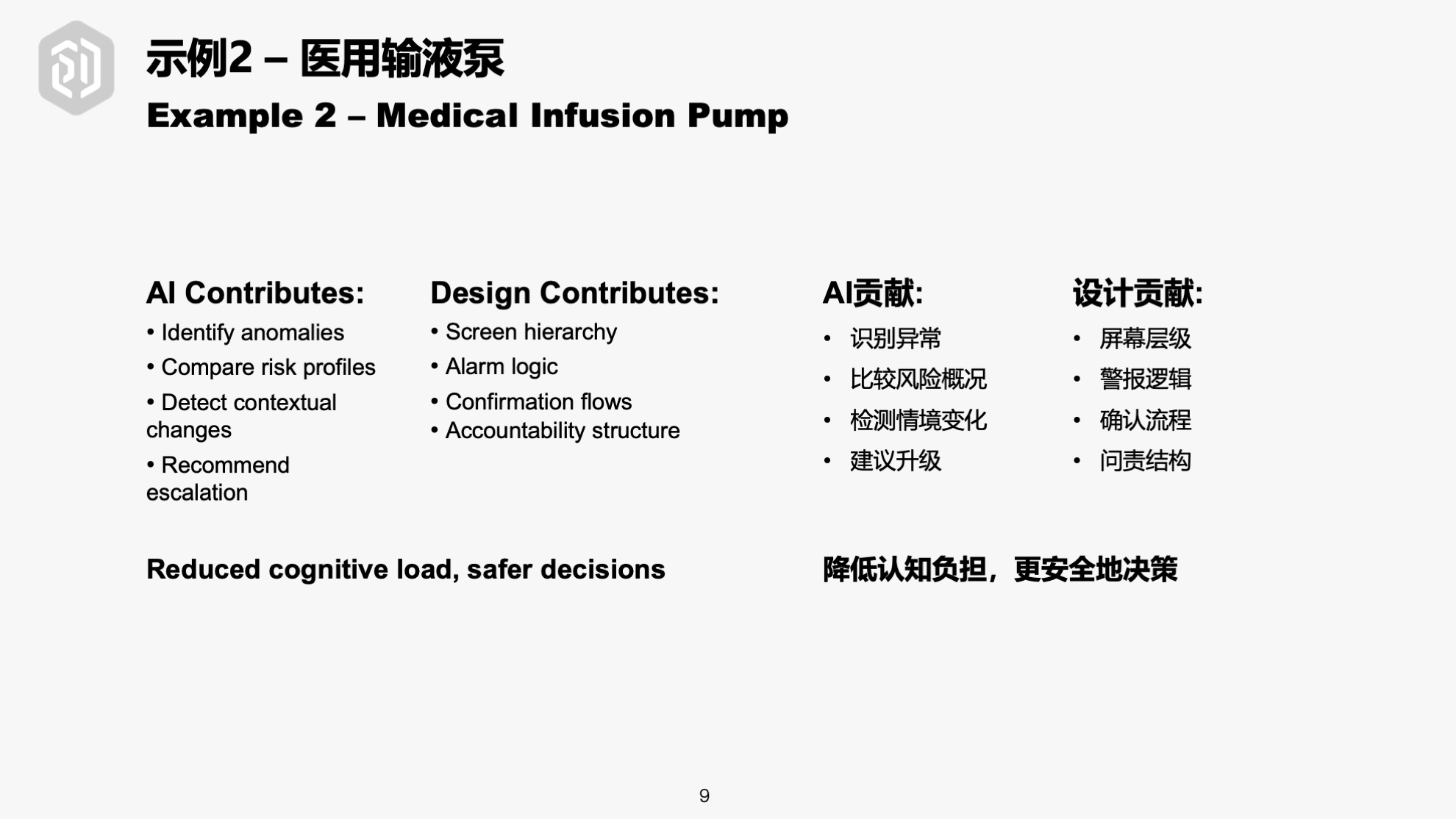
Now let us move to the hospital.
A traditional infusion pump is a bounded device. It is programmed directly by a clinician. Its intelligence is limited, its interface is local. Its logic is relatively fixed. In that state, design focuses on the form of the device and the clarity of the interface: button shape, screen hierarchy, handle placement, alarm audibility, and the basic ergonomics of use under pressure.
Then the device becomes networked. It can connect to hospital systems, use structured drug libraries, work across different ward types, and participate in a broader informational environment.
This is where the distinction again becomes useful. Artificial intelligence may identify anomalies, compare patient conditions against risk profiles, recognize patterns that deserve attention, and recommend caution or escalation. But clinicians do not encounter an algorithm in the abstract. They encounter a screen hierarchy, an alarm logic, a confirmation sequence, and an interface they must trust under pressure.
That is where design matters.
Design determines what information is primary and what remains secondary. It determines which warning is actionable and which simply adds stress. It determines whether the device supports rapid and safe decision-making or merely generates more cognitive load.
Now imagine that system becoming context-sensitive. At night, with fewer staff, the meaning of an alarm may be different. For a high-risk patient, a default workflow may no longer be appropriate. For a routine case, an overly aggressive warning system may create more noise than value.
Artificial intelligence may detect these contextual changes. Design determines how they are expressed. A different information hierarchy. A different alarm structure. A different pattern of confirmation and override.
And design also determines accountability. What can the nurse do directly? What requires another level of authorization? What remains in the professional layer of the interface?
So again, artificial intelligence contributes analysis, detection, and recommendation. Design contributes clarity, pacing, explanation, and a usable structure of trust.
That is not an aesthetic afterthought. It is the design of safety in a high-consequence environment.
10
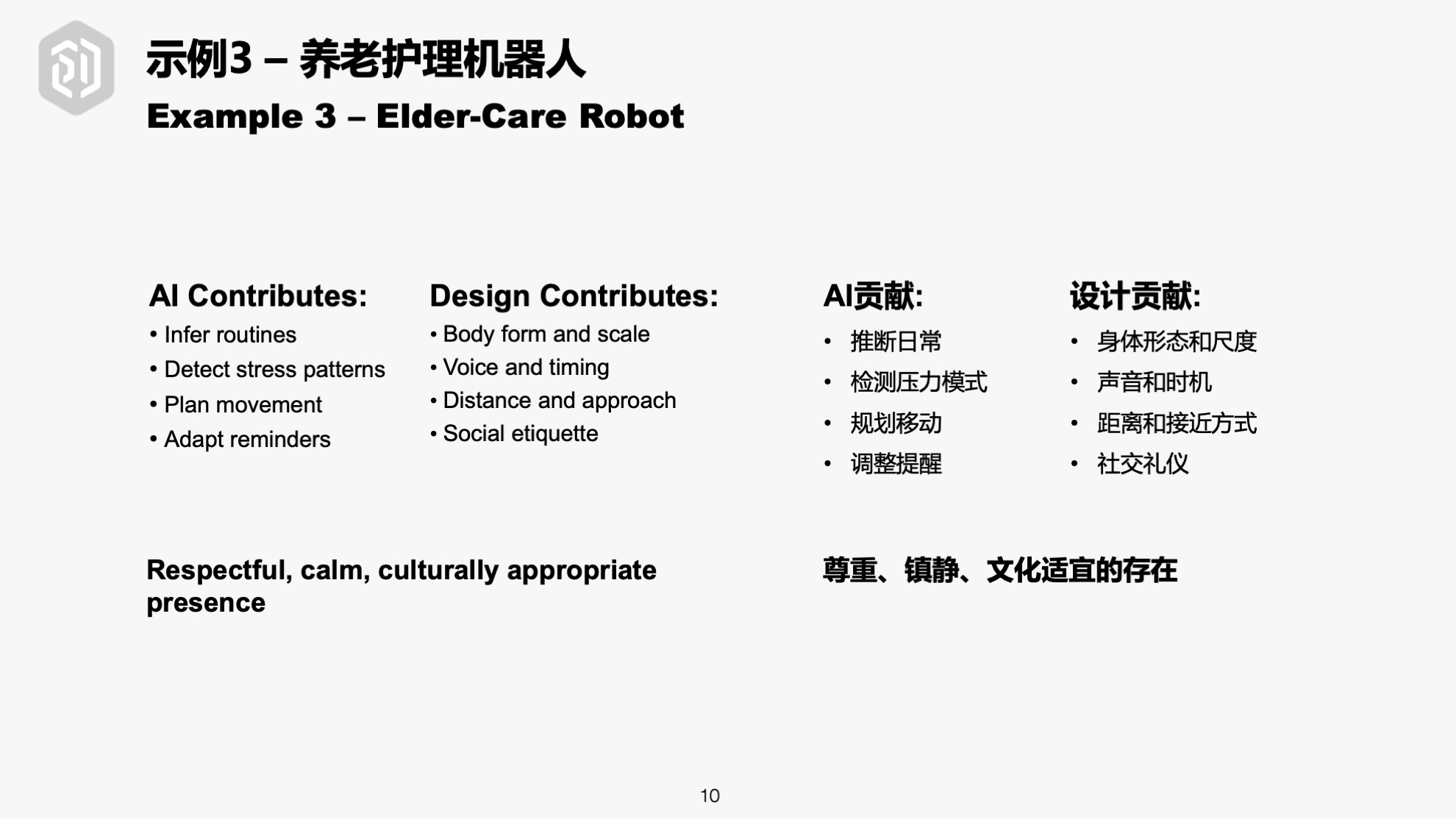
My third example is shorter, but in some ways more revealing.
In elder care, the issue is not only function, it is presence.
A simple assistive device can deliver the same signal to everyone. A more advanced robot can vary reminders, voices, routes, and routines. A connected care environment can add monitoring, scheduling, and adaptive support.
But the key question is not simply whether the system is intelligent. It is whether that intelligence is socially and culturally appropriate. Artificial intelligence may infer routines, detect inactivity, recognize stress patterns, plan movement, or adapt reminders to time and circumstance.
Design determines how that intelligence takes social form.
The body of the robot. Its scale. Its distance from the user. Its speed of approach. Its voice. Its timing. Its screen behavior. Its ability to signal attention or non-interruption.
If the system infers evening anxiety, design may translate that into softer light, slower movement, quieter speech, and simpler language. If it detects a family visit, design may tell the robot to withdraw slightly, angle its body differently, reduce the visibility of its screen, and shift into a less interruptive social role. If it replans its path through a corridor, design decides how that intention is communicated to others around it.
So once more, artificial intelligence contributes sensing and adaptation. Design contributes presence, etiquette, and interpretability. And in care settings, that is decisive. Because intelligence is not accepted simply because it is accurate. It is accepted when it feels respectful, calm, understandable, and appropriate to the setting.
These examples lead to my final point.
If this is where AI is going, then this is also where design education must go. We need more than graduates who know how to use AI tools. We need graduates who can shape the contexts in which AI can act well.
11
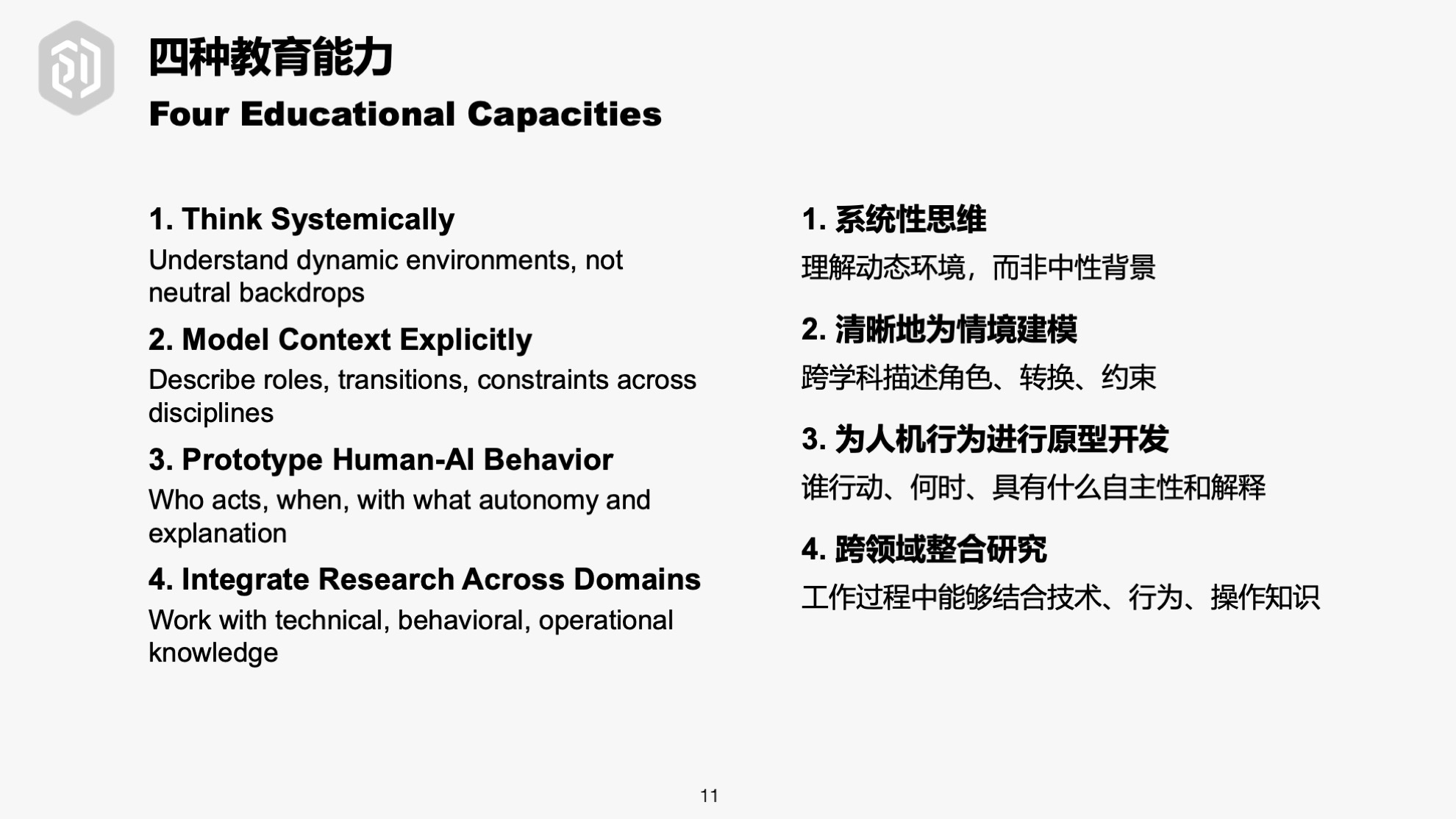
That requires at least four capacities.
First, they must be able to think systemically. They need to understand that factories, hospitals, and care environments are dynamic systems, not neutral backdrops for isolated products.
Second, they must be able to articulate and model context explicitly. It is not enough to speak broadly about empathy or the user journey. They must be able to describe roles, transitions, permissions, constraints, exceptions, and states in forms that can be shared across disciplines.
Third, they must be able to prototype human-AI behavior, not only use AI to model objects and screens. They need to ask: who acts, when, with what degree of autonomy, with what explanation, and with what possibility of override?
Fourth, they must be able to conduct and integrate research across domains. Design increasingly depends on our ability to work with technical, behavioral, and operational knowledge together. Very importantly, they must be able to work with ethics and moral grounding.
At SUSTech School of Design, that is increasingly the direction we will pursue. We need to educate designers who can move fluently between design judgment and technical collaboration, and who can work on forms, interfaces, interactions, and systems for context-sensitive AI.
12
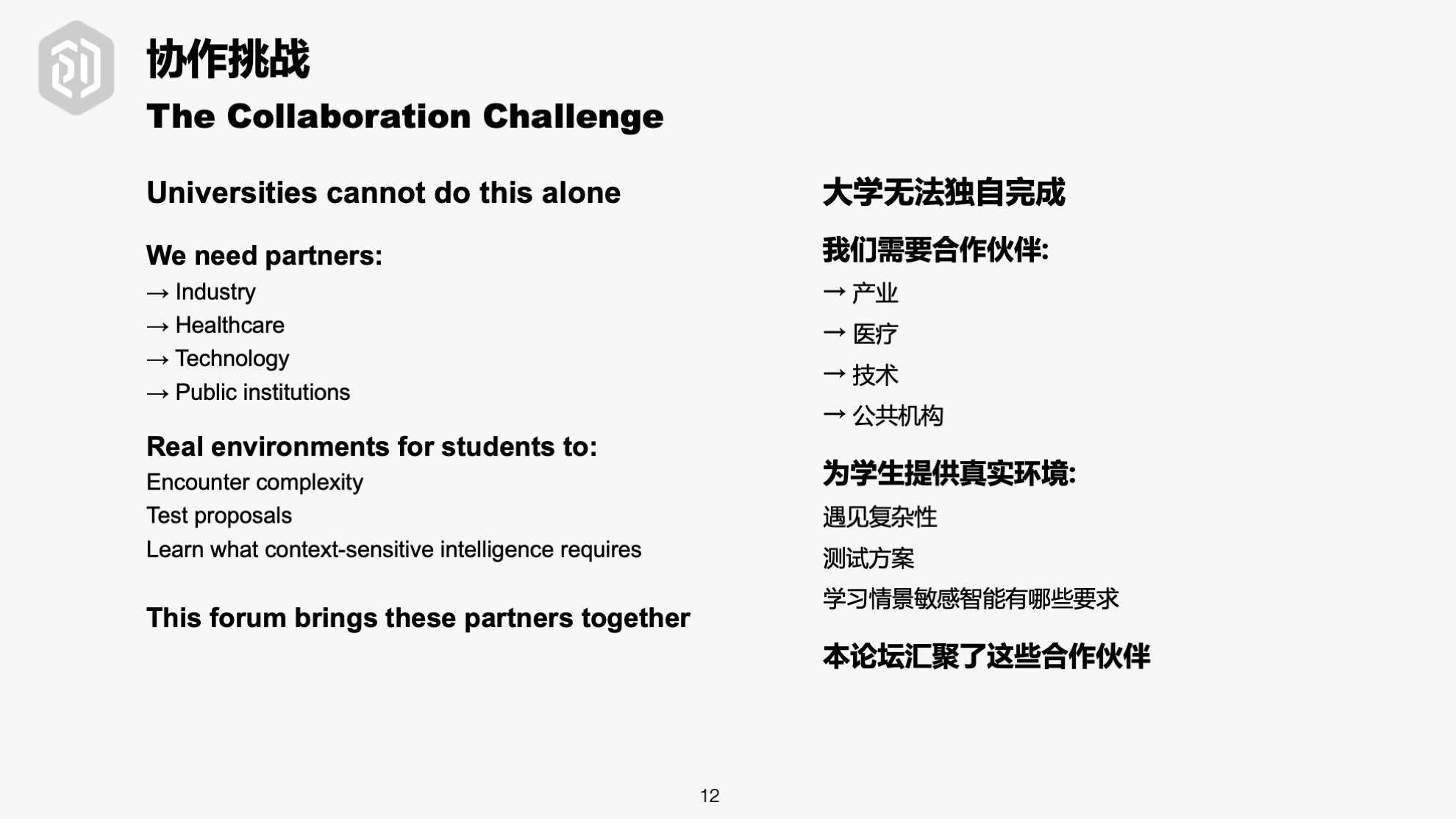
But universities cannot do this alone. We need partners in industry, healthcare, technology, and the public sector. We need real environments in which students can encounter complexity, test proposals, and learn what context-sensitive intelligence actually demands.
And that is one reason this forum matters. It brings together exactly the kinds of institutions that could build that next stage together.
So let me close in the language of this event. Artificial intelligence expands what systems can do. Artistic intelligence helps determine what those systems should be like in human experience.
If we understand artistic intelligence through design, then its contribution is not to decorate technology after the fact. Its contribution is to make intelligence meaningful in context — to make it legible, trustworthy, adaptive, and appropriate.
Our next advantage will not come only from more powerful models. It will also come from a better grasp of context engineering. And that is where design matters. And it is of lasting value in a rapidly changing technology environment.
If we take that seriously, then the Greater Bay Area can become more than a center of advanced manufacturing. It can become a leading place where artistic intelligence and artificial intelligence are brought together through design — in the forms, interfaces, and interactions of a new generation of context-sensitive systems.
In that sense, DIA is more than an award. It is a platform for identifying, exhibiting, and advancing the kinds of collaborations we now need between design, AI, education, and industry.
Thank you.
Part of the content sourced from: Design Intelligence Award
Editor: Yiran Zhao
Reviewed by: Xu Li
Apr 21. 2023 - Latest News

Nov 18. 2024 - Latest News

Jul 24. 2026 - Latest News